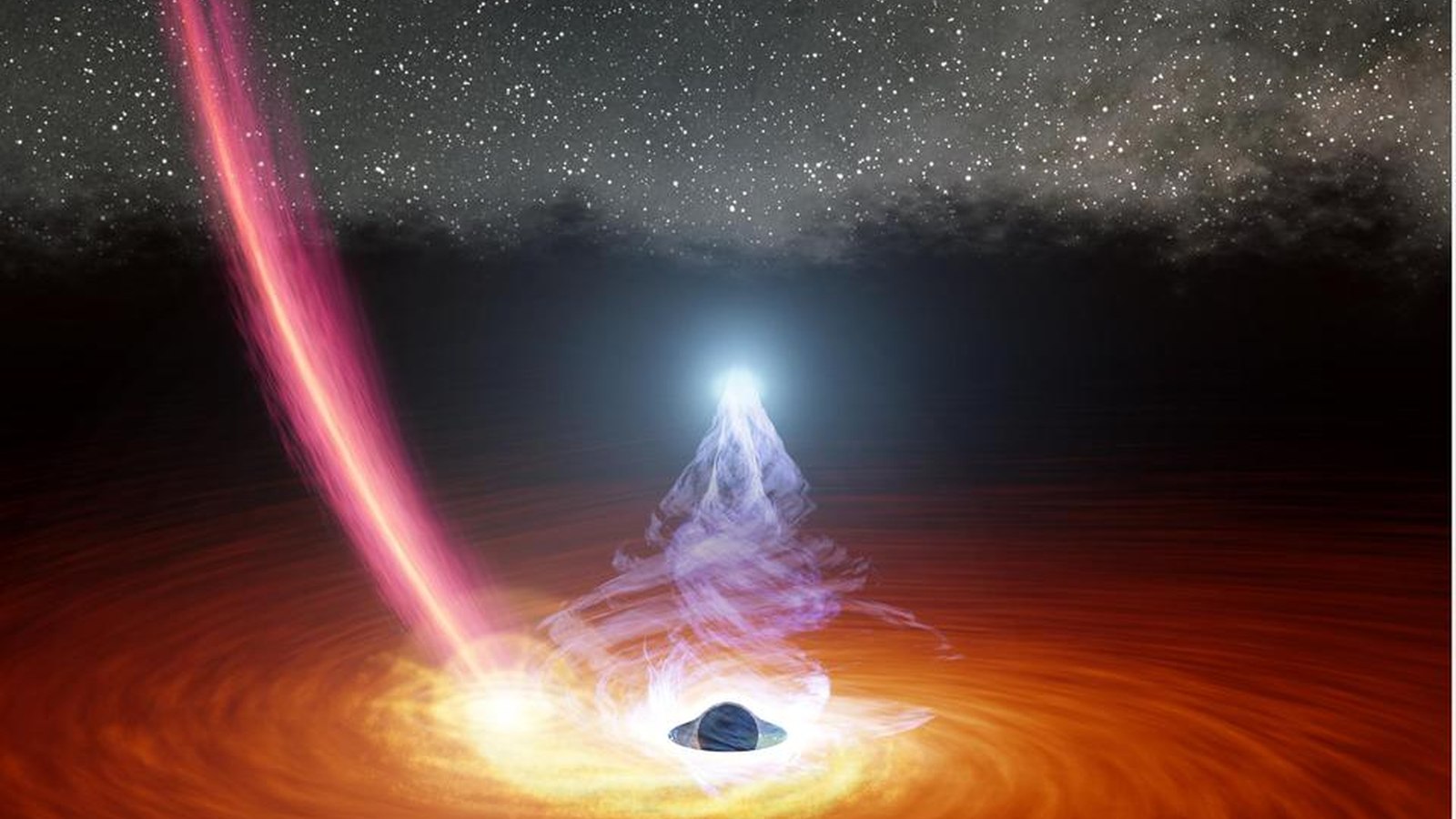
A black hole is not a cosmic vacuum cleaner roaming the neighborhood. It is a region where gravity has become so intense that, inside a boundary called the event horizon, even light cannot climb back out. Outside that boundary, physics remains ordinary — clocks tick, orbits work, coffee cools.
If the Sun were somehow replaced by a black hole of the same mass, Earth would continue on roughly the same yearly path. We would freeze in the dark, but we would not be slurped inward. Distance and mass still rule. Drama needs proximity.
Why galaxies care
Nearly every large galaxy appears to host a supermassive black hole at its center. Ours is called Sagittarius A*. It weighs about four million Suns, yet from 26,000 light-years away it is a quiet neighbor — detectable in radio and infrared, not a daily threat.
Over cosmic time, though, these central engines help regulate how galaxies grow. Jets and winds from feeding black holes can heat surrounding gas, slowing the birth of new stars. The chemistry of the disk that made our Sun was written, in part, by earlier generations of stars — and by the violent bookkeeping of galactic centers.
You are not falling into a black hole. You are living in a universe that learned to make you while black holes kept score.
Stellar-mass black holes — a few to tens of solar masses — form when massive stars collapse at the end of their lives. Supermassive ones grew through mergers and long feeding histories we are still mapping. Neither class is “out to get you.” Both are endpoints of gravity doing what gravity does when enough mass occupies a small enough volume.
The everyday connection
GPS satellites must correct for Einstein’s relativity — clocks run at slightly different rates in orbit than on the ground. The same theory that predicts black holes also keeps your maps honest. LIGO and Virgo listen for spacetime ripples from colliding black holes; those detections confirm that the extreme objects in textbooks are real, dynamical, and frequent on cosmic scales.
Even the phrase “singularity” — the idealized point where classical equations break — is a reminder of humility. Nature does not owe us complete equations. It owes us consistency with observation. We fill in the rest carefully.
So when a headline says a black hole “devoured” a star, translate it: matter fell across a horizon; light and particles from the surrounding chaos reached our telescopes years later; and for a moment, Earth got a postcard from a place that cannot send one from the inside.
Your ordinary day still happens on a rock orbiting an ordinary star in the suburbs of a spiral galaxy. The black hole at the center is part of that architecture — distant, dense, and strangely relevant.
No Ground. Stay curious.