 No Ground
Betelgeuse is the bright orange-red star that marks the shoulder of Orion, and it may not be alone. New radio observations suggest that a small, hidden companion star is passing through its outer atmosphere and stirring it up.
The companion has a name: Siwarha, which means “her bracelet.” It is a nod to the name Betelgeuse itself, which comes from an Arabic phrase meaning “the hand of al-Jawza.” Siwarha is far too faint to see directly in these observations. It is estimated to be tens to hundreds of times too dim for the radio telescopes to detect on its own, so astronomers look for what it does to Betelgeuse instead.
What the telescopes saw
A team led by L. D. Matthews of MIT Haystack Observatory used the Very Large Array in New Mexico and the ALMA telescope in Chile. They collected data between 2021 and 2026 at seven radio frequencies. Their results were published in The Astronomical Journal.
They looked at the shape of Betelgeuse’s atmosphere, the thin outer layers around the star. It does not stay round. It looks more stretched when Siwarha is at its greatest apparent separation from the star, and rounder when the companion is predicted to pass in front of or behind it. That pattern is the main evidence that something is circling inside the atmosphere.
Find Betelgeuse in your sky tonightFree sky map for where you are: when it rises and which way to face.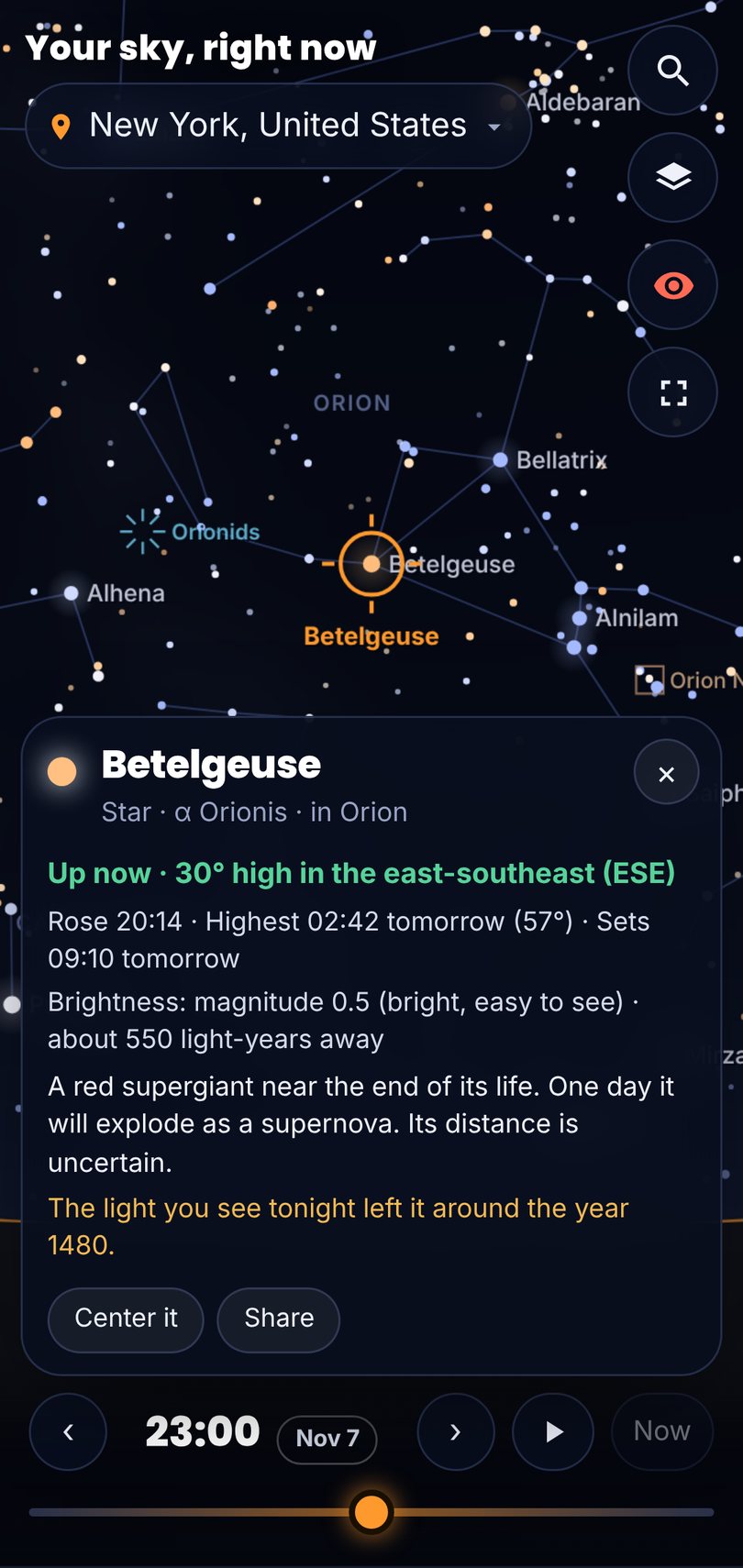

The puzzle it may solve
Betelgeuse has a brightness cycle of about 2,100 days, around 5.8 years. In 2024 astronomers proposed that a companion star could explain it. This new work adds support. It also found that the atmosphere has returned to normal temperatures after the star’s Great Dimming a few years ago. At about 2.7 times the star’s radius, it measures roughly 3,500 kelvins, and a cooler layer reaches about 2,200 kelvins.
How the evidence built up
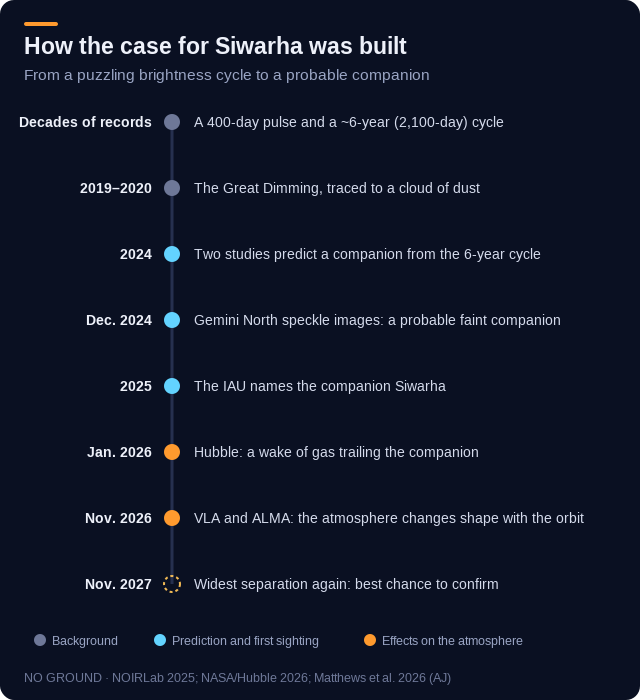
The radio study is the latest step in a story that has moved quickly. Astronomers have long known that Betelgeuse brightens and fades on a main cycle of about 400 days, with a slower cycle of about six years on top. In 2019 and 2020 the star faded so much that people wondered whether it was about to explode. Astronomers traced the Great Dimming to a large cloud of dust thrown off by the star.
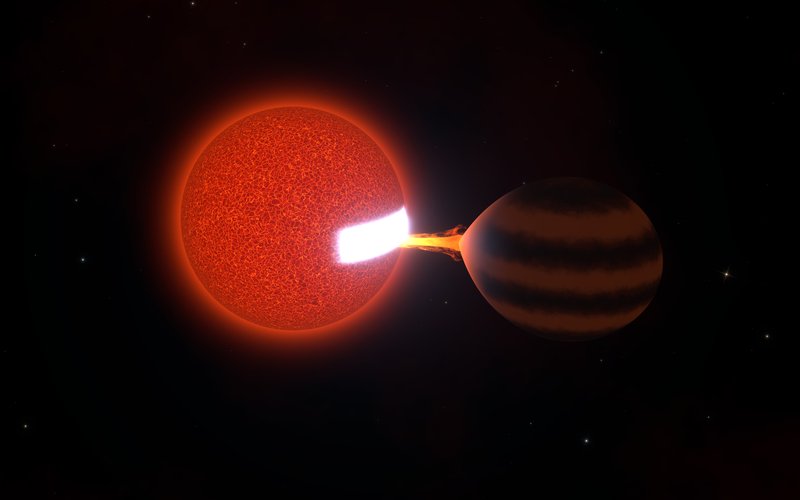
That event sent researchers back to old records. In 2024, two separate studies used decades of brightness and motion measurements to argue that the six-year cycle is caused by a companion star in orbit. Searches with the Hubble and Chandra space telescopes did not find it. Then, in July 2025, a team led by Steve Howell of NASA’s Ames Research Center reported a probable direct sighting, made with a speckle camera on the Gemini North telescope in Hawaii. Speckle imaging takes very short exposures that freeze the blurring of Earth’s air. The faint spot was about six magnitudes fainter than Betelgeuse, roughly 250 times dimmer. The team estimated that it is a young star of about 1.5 times the Sun’s mass, orbiting only about four times the Earth–Sun distance from Betelgeuse’s surface, inside its extended atmosphere. The detection was right at the limit of what the telescope can do, so the team called it probable, not certain.
In January 2026, a team led by Andrea Dupree of the Center for Astrophysics | Harvard & Smithsonian, who is also a co-author of the new radio study, reported a different kind of evidence. Using Hubble and ground-based telescopes, they found signs of a dense, expanding wake of gas trailing behind the companion as it moves through Betelgeuse’s atmosphere. The International Astronomical Union had by then given the companion its name, Siwarha. The new radio results add a third line of evidence: the shape of the atmosphere seems to follow the orbit.
What is still unknown
The team says more observations are needed to confirm the link between Siwarha’s orbit and the changes in the atmosphere, and it is still unclear how strongly the companion affects Betelgeuse. So this is strong evidence, not a final answer.
What a companion means for Betelgeuse’s future
Betelgeuse is about 10 million years old, young for a star but near the end of its life, because huge stars burn through their fuel fast. Its radius is around 700 times the Sun’s. NOIRLab says the companion probably formed at the same time, but will not last: tidal forces should drag it into Betelgeuse, which scientists estimate will happen within the next 10,000 years.
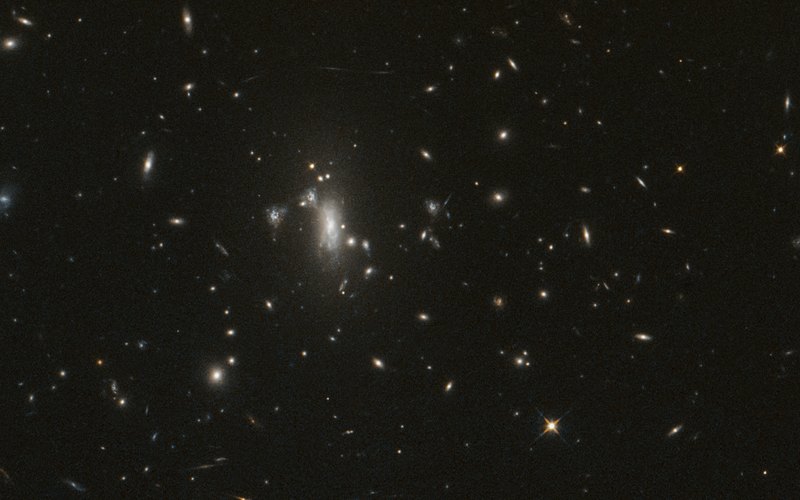
Betelgeuse itself is expected to end as a supernova one day, though not on any timescale anyone can predict. Not every giant star explodes cleanly. Some appear to vanish without exploding, and some put on huge outbursts that look like supernovas but are not, like the supernova impostor AT 2016blu. A companion can change how a star sheds mass, which is one reason astronomers want to pin Siwarha down.
The best chance comes in November 2027, when the companion will again be at its widest separation from Betelgeuse and easiest to see. Howell’s team plans to observe before and during that time.
How to see Betelgeuse
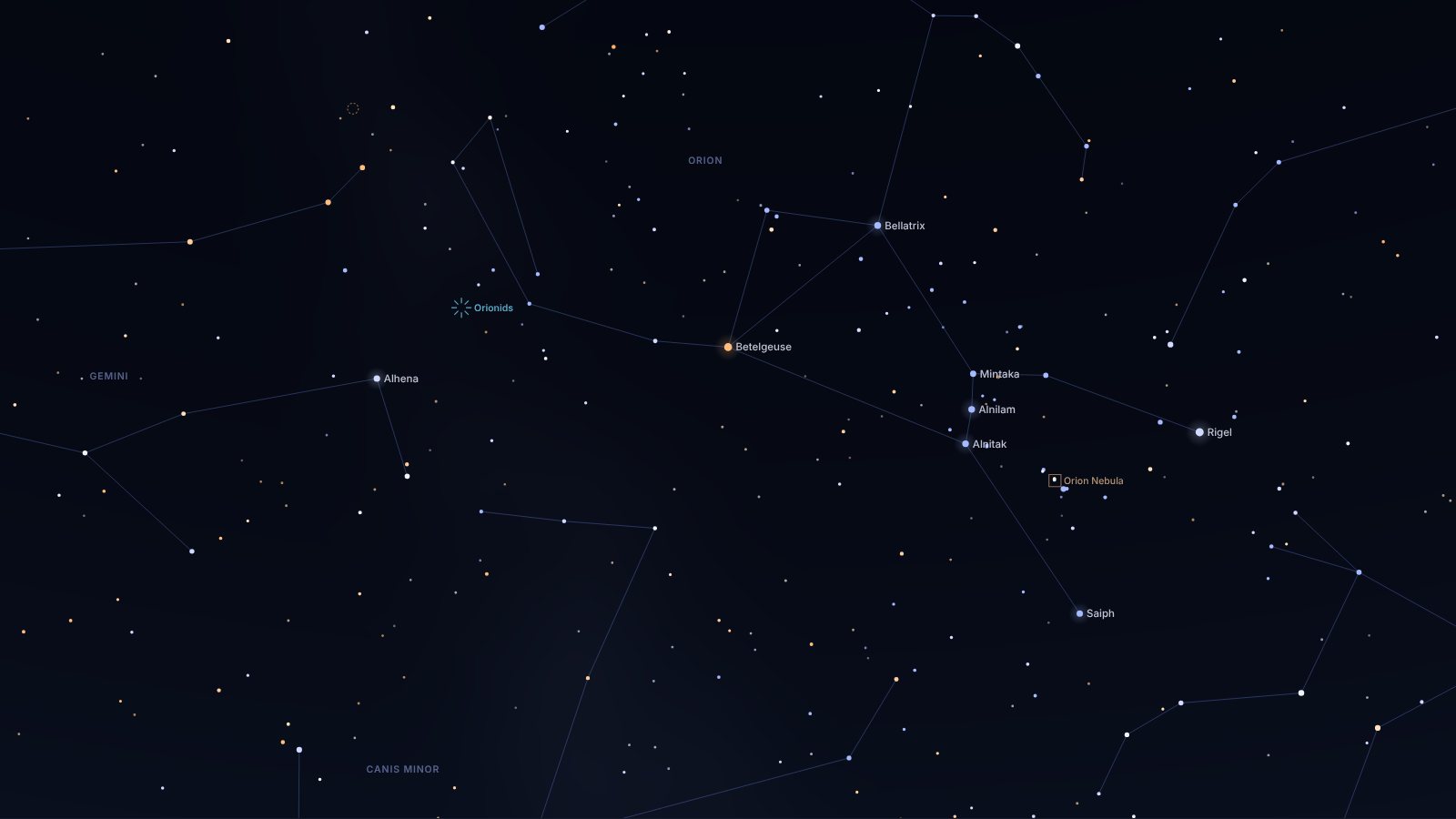
Orion climbs into the evening sky in the east from November, and like all stars it rises about four minutes earlier each night. When this story was first published, in early November, Betelgeuse rose at about 8:14 p.m. in New York and was around 30 degrees up by 11 p.m. By January it is already well up in the east soon after dark. Find the three stars of Orion’s belt in a row. Betelgeuse is the bright orange-red star above and to the left of the belt, as seen from the Northern Hemisphere. Your town will see different times.
It is a red supergiant, so large that it would swallow the orbits of Mercury, Venus, Earth and Mars if it took the Sun’s place. You do not need a telescope or binoculars, and you will not see Siwarha: it is far too close to the star and too faint. Our guide to why the North Star never moves explains why Orion appears to swing across the sky through the night while Polaris stays put.
Bottom line: New radio observations point to a hidden companion, Siwarha, stirring Betelgeuse’s atmosphere. More data is needed to confirm it.
No Ground. Stay curious.