 No Ground
Somewhere in the southern sky, a dead star, likely only about a dozen miles wide, is spinning 261 times every second. For years it hid inside NASA’s own public data, even though astronomers had long suspected something was there. The best search method available threw the equivalent of 600 years of computer time at it and still came up empty.
Then a team borrowed a trick from code-breakers. With it, they found the star, now named PSR J1622−7204, using about 10 hours of computing on a single standard processor. The result, published Nov. 19, 2026, in the journal Physical Review Letters, could unlock many more hidden pulsars, including a kind that has been almost impossible to find.
A cosmic lighthouse that was hiding in plain sight
A pulsar is a kind of neutron star: the crushed core left behind when a massive star runs out of fuel and collapses. NASA describes neutron stars as roughly the mass of the Sun squeezed into a ball about 12 miles across. The matter is so dense that a sugar cube of it would weigh about a billion tons on Earth.
Neutron stars spin, and many shoot beams of radiation from their magnetic poles. If a beam happens to sweep across Earth, we see a flash once per turn, like a lighthouse. That is a pulsar. The first one was found by accident in 1967 by Jocelyn Bell (now Jocelyn Bell Burnell), then working on her doctorate at the University of Cambridge in England. She noticed radio blips arriving every 1.33730 seconds, so regular that she and her supervisor at first could not believe they were natural.
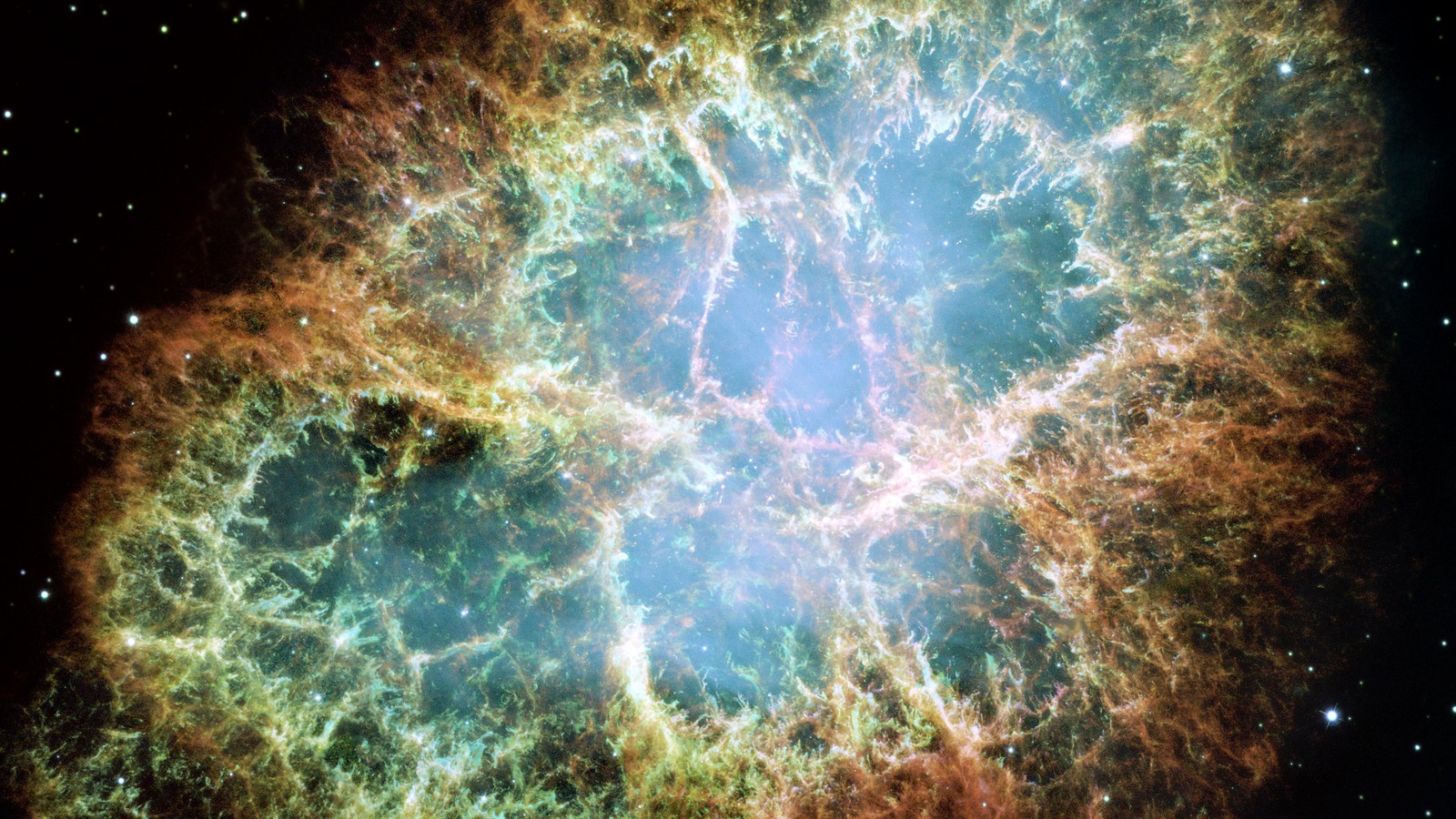
The new pulsar is far faster. At 261 turns per second, it completes a full spin about every 3.8 milliseconds. Astronomers call fast spinners like this millisecond pulsars. For comparison, the famous pulsar inside the Crab Nebula, shown at the top of this page, flashes about 30 times a second. The Crab is what remains of a star that exploded in a supernova seen from Earth in the year 1054.
Pulsars come from some of the most violent endings in the universe: they are born when massive stars collapse. If you want to see how tangled those stellar lives can get, we covered astronomers watching a giant star swallow its companion, and the opposite case of stars that seem to vanish without exploding.
Why gamma-ray pulsars are so hard to find
This pulsar was found in data from NASA’s Fermi Gamma-ray Space Telescope. Fermi launched in 2008 and scans the entire sky every three hours in gamma rays, the highest-energy form of light. Many pulsars glow in gamma rays, but finding them this way is brutal.
The problem is how few gamma rays actually reach the telescope. According to the research paper, Fermi typically catches only about one gamma-ray photon from a pulsar for every 100 million or so rotations. Over many years, a faint pulsar may deliver fewer than about 1,000 photons in total, and those are mixed in with photons from other sources across the sky. By our math, a star spinning 261 times a second turns roughly 120 billion times in 15 years. Fermi sees only a tiny scattering of those turns.
So astronomers cannot simply watch the flashes. Instead, they have to guess the pulsar’s exact spin rate, how quickly that spin is slowing down, and its precise position in the sky. They also have to account for Fermi itself moving around the Sun with Earth, which shifts when each photon arrives. Only when every guess is almost exactly right do the scattered photons line up into a clear beat.
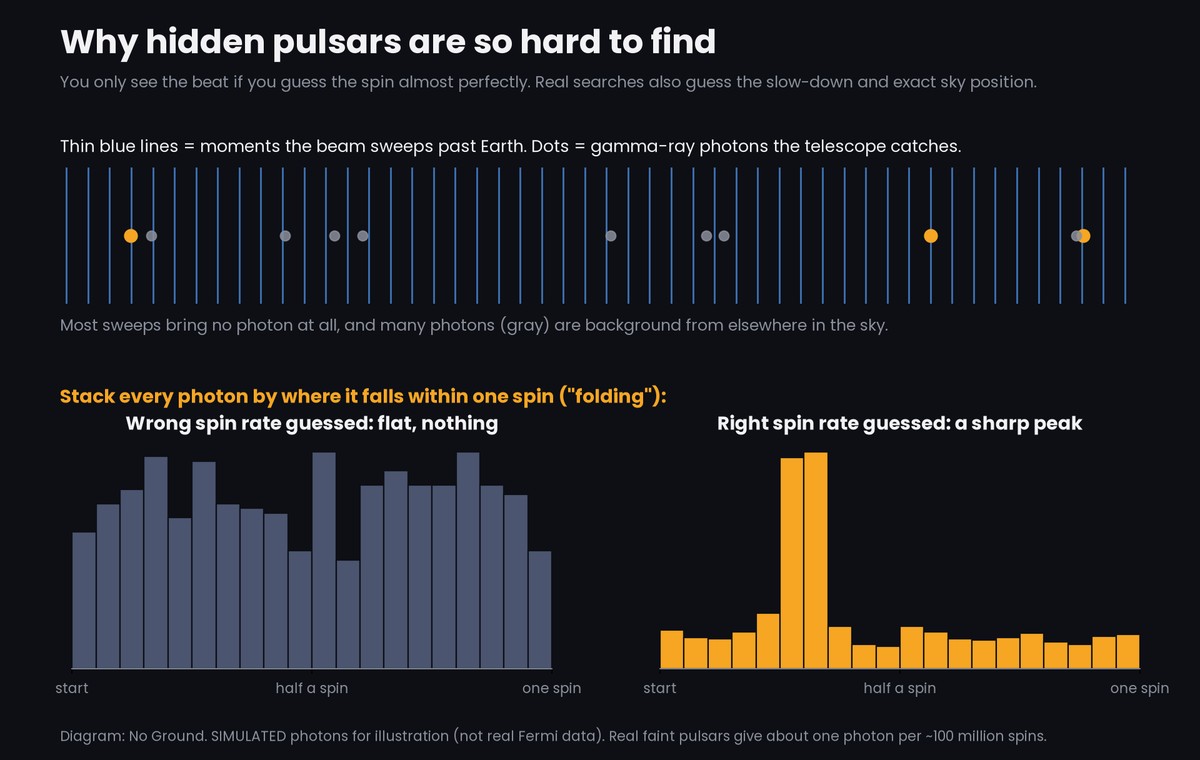
“We have a four-dimensional grid, and we must search each direction with millions of trials in it,” lead author Daniel Pook-Kolb of the Max Planck Institute for Gravitational Physics in Hannover, Germany, told NASA. “There’s just not enough computing power on Earth to do it.” The paper estimates a true brute-force search would need around 1022 trials, a one followed by 22 zeros.
Until now, the workaround was raw computing muscle. The Einstein@Home project borrows idle time on volunteers’ home computers around the world, and it has found more than 80 new pulsars in Fermi data. But even with that crowd, a single discovery typically took the equivalent of hundreds of computer-years.
The code-breaker’s shortcut
The breakthrough came from Dotan Gazith and Barak Zackay at the Weizmann Institute of Science in Israel. They realized the pulsar hunt could be turned into a famous geometry problem: finding the shortest arrow, or vector, in a lattice, which is a regularly spaced grid of points stretching across many dimensions.
Explore your sky tonightLive sky map for where you are: planets, the ISS and bright stars above your horizon.That problem matters a lot to cryptographers. Some of the newest encryption methods, including standards that the U.S. National Institute of Standards and Technology finalized in 2024, are built on lattices because they are expected to resist attacks even from future quantum computers. Researchers trying to test and break those systems have built very fast lattice tools, and the pulsar team put those tools to work on starlight instead.
“We have nothing to do with cryptography in our analysis here, but those algorithms can help us solve the problem of searching for pulsars in our data,” Gazith said.
In practice, the team aimed at a gamma-ray source called 4FGL J1622.2−7202, which had long looked like it might hold a pulsar. Each trial run took a random handful of 80 photons from among the ones most likely to come from the source and asked the lattice tools for an answer. A run took less than five minutes on one processor core, the kind of power a normal laptop has to spare. About 1 in 100 runs hit the pulsar. When the team then checked the candidate against the full Fermi data, the signal was so strong it could not be a fluke.
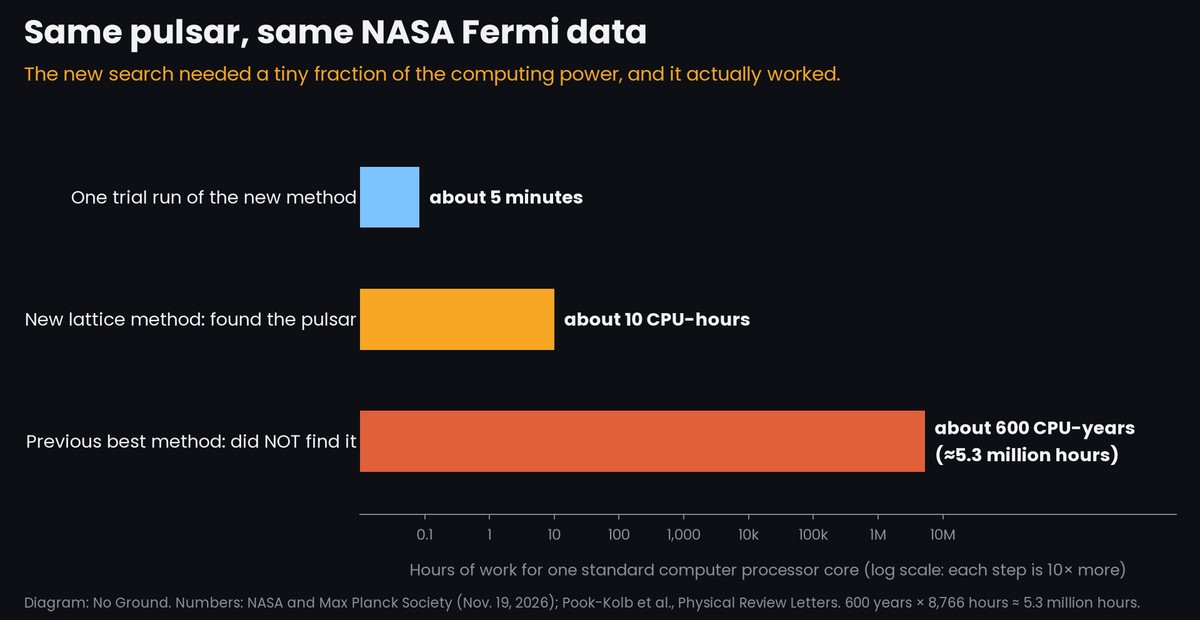
Add it all up and the hunt needed roughly 10 hours of processor time. The previous best method, according to NASA and the Max Planck Society, ran the equivalent of 600 years of processor time, more than 5 million hours by our math, and still failed to find this pulsar. The researchers describe the new approach as about a million times faster.
Why open data made this possible
None of the people who cracked this puzzle had to build a telescope. After a first year of calibration, all of Fermi’s data became public, and it is still released as soon as it is processed. “All 18 years of Fermi data have been made public, and the data just keeps growing,” said co-author Colin Clark of the Max Planck Institute.
That openness has already paid off big. NASA’s third catalog of Fermi pulsars listed 294 confirmed gamma-ray pulsars plus 34 suspects, 27 times as many as were known before Fermi launched. Only about one in ten of the roughly 3,400 known pulsars also pulse in gamma rays, so every new one counts.
“Any search that one team is doing, another team can just go and do that and check the search,” said Elizabeth Hays, Fermi project scientist at NASA’s Goddard Space Flight Center. “It’s made all of the science better.”
The next target: pulsars with partners
The team’s bigger goal is pulsars in binary systems, where the dead star orbits a companion. The orbit makes the pulses speed up and slow down in a rhythm of their own, adding even more unknowns to the guessing game. With older methods, those searches were close to hopeless unless astronomers already knew a lot about the orbit.
“We know that there are probably tens or maybe even hundreds of these pulsars in the data set that we just couldn’t find,” Clark said. The plan is to combine the new algorithm with the volunteer computers of Einstein@Home.
There is a payoff beyond the count. Steady millisecond pulsars are some of the most precise natural clocks known. NASA notes that astronomers time collections of them to look for gravitational waves, ripples in space-time too slow for today’s detectors to catch. Future observatories may hunt those ripples a different way, as we explained in our story on planets around dead stars and the LISA mission. More pulsars means more clocks, and more clocks means a sharper ear for the universe.
Bottom line: A pulsar spinning 261 times a second, PSR J1622−7204, was found in 15 years of public NASA Fermi data using math borrowed from code-breakers. It took about 10 hours of computing, where the previous best method failed after the equivalent of 600 years. The same trick could reveal many more hidden pulsars, including ones in binary systems.