 No Ground
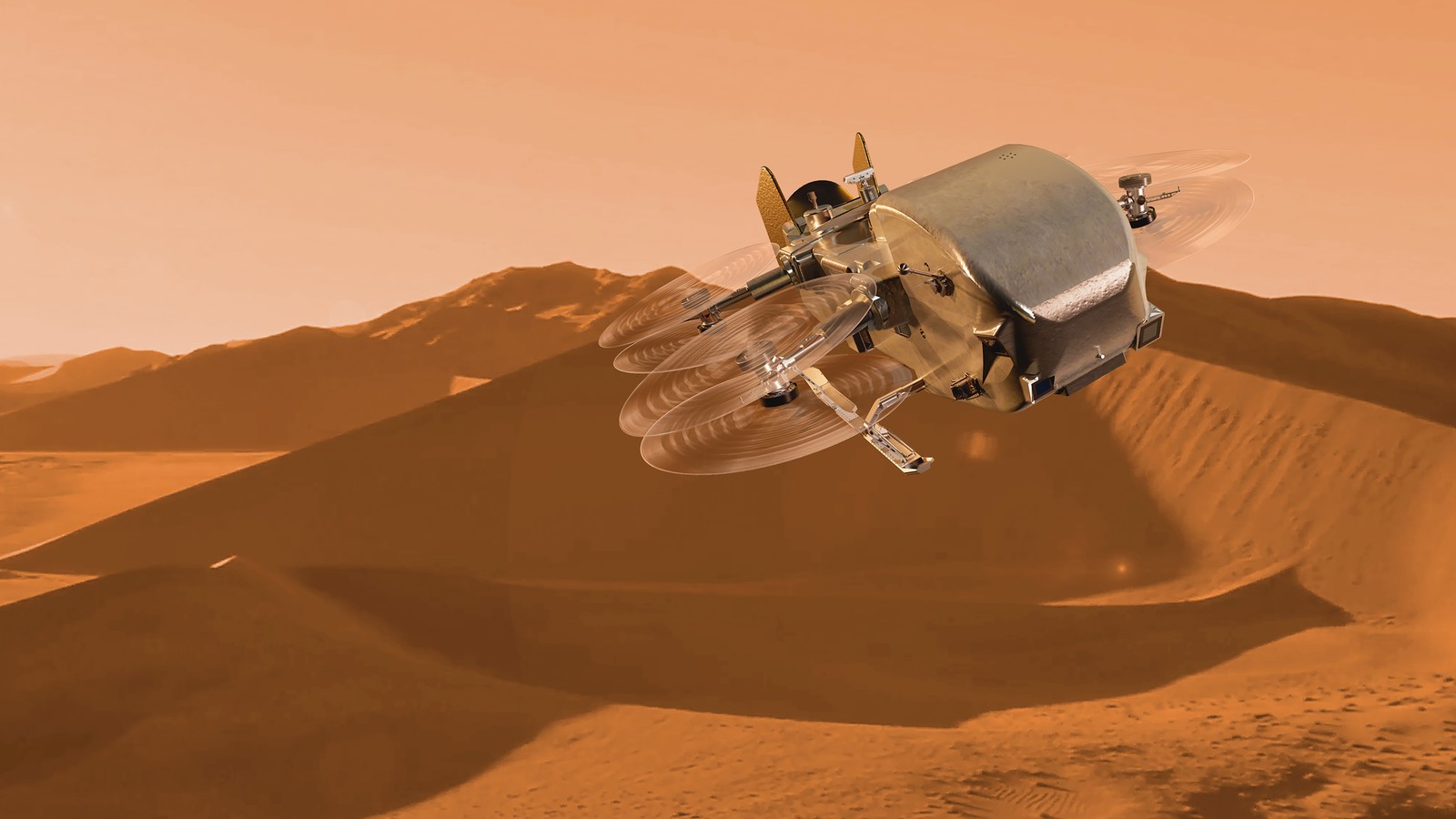
You may never stand on Saturn’s moon Titan, but your name can get there. NASA has opened a public campaign, called “Journey to Titan,” that will put names on a microchip flying aboard Dragonfly, the rotorcraft the agency is building to explore Titan by air.
Anyone can sign up. Everyone who does gets a personalized digital boarding pass to mark their place on the mission. NASA announced the campaign on Oct. 29, 2026, and says the passenger list stays open until 11:59 p.m. EST on Jan. 15, 2027.
How to send your name
Go to NASA’s official sign-up page at go.nasa.gov/dragonfly-names, fill in the short form and submit it to get your boarding pass. NASA’s Dragonfly page notes that the boarding passes are also available in Spanish. The announcement does not mention any fee.
Use only the official NASA link. If a site asks you to pay to “send your name to Titan,” it is not the NASA campaign.
What Dragonfly is
Dragonfly is a SUV-sized, nuclear-powered rotorcraft, a flying machine that lifts off with spinning rotors like a drone. NASA calls it the first science mission designed to fly and explore the surface of another world. It is being assembled at the Johns Hopkins Applied Physics Laboratory (APL) in Laurel, Maryland.
NASA’s mission page lists the launch as no earlier than July 2028 and the arrival at Titan as late 2034. That is a trip of about six years across roughly a billion miles.
Explore your sky tonightLive sky map for where you are: planets, the ISS and bright stars above your horizon.
Why Titan
Titan is Saturn’s largest moon and one of the strangest places in the solar system. It has a thick, nitrogen-rich atmosphere, rivers and lakes of liquid methane, seasons, sweeping dunes and a surface rich in organic material. NASA describes it as the distant world most similar to our own, though it is far colder.
NASA is clear that Dragonfly is not a mission to detect life. Instead it will study prebiotic chemistry, the chemistry that came before biology, to help scientists understand the ingredients and conditions that life needs.
Why fly on Titan
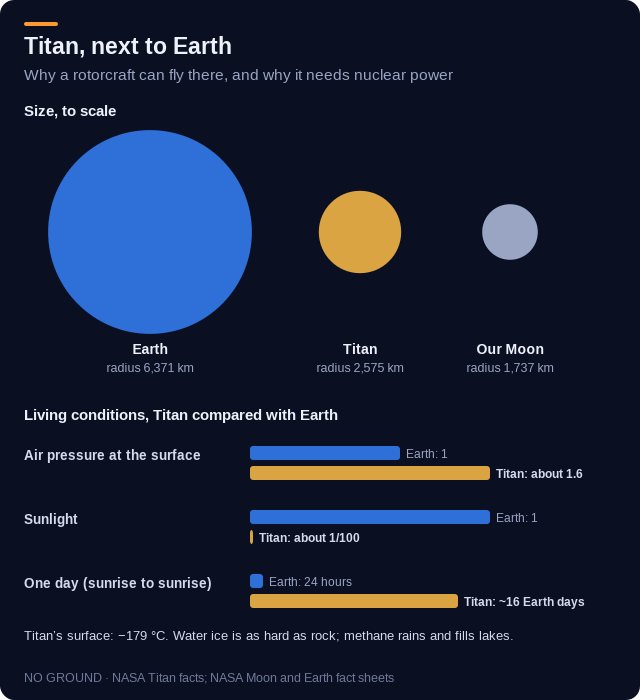
Titan is one of the few places in the solar system where flying is easier than on Earth. At the surface, NASA says, the air pressure is about 60 percent greater than ours, roughly what a swimmer feels 15 metres underwater. The moon’s gravity is also much weaker than Earth’s. Thick air and low gravity together mean that rotor blades get plenty of lift for little power. NASA says the atmosphere is also calm, and that flying frees Dragonfly from the rough, sandy ground a wheeled rover would have to cross.
The hard part is energy. Titan is about ten times farther from the Sun than Earth is, and NASA says sunlight there is about 100 times fainter than here, before it even reaches a thick orange haze. Solar panels would not work. So Dragonfly carries a Multi-Mission Radioisotope Thermoelectric Generator, or MMRTG, the same kind of nuclear power source used by the Curiosity and Perseverance rovers on Mars. It turns the heat of decaying plutonium into a steady trickle of electricity, which charges a 134 amp-hour battery. The battery powers the flights. Curiosity’s own hunt for organic molecules, which we covered in our story on Mars organics, runs on the same kind of generator.
It is also cold. The surface sits at about −179 °C (−290 °F), so cold that water ice behaves like rock, and methane and ethane play the part that water plays on Earth, raining from clouds and filling lakes and seas. Titan’s thick air invites a comparison with Venus, but the two are opposites. Venus’s atmosphere presses down about 90 times harder than Earth’s and is hot enough to melt lead; Titan’s is only modestly denser than ours, and bitterly cold.
How it will explore
Most landers stay where they touch down. Dragonfly will fly. Over a planned mission of about 3.3 years, its rotors will carry it for miles across Titan, stopping at different geological sites, including dunes and a young impact crater called Selk. NASA expects one flight every one to two Titan days. A Titan day, called a Tsol, lasts about 16 Earth days.
At each stop, Dragonfly will collect samples of surface material and analyze them with instruments inside the rotorcraft. The goal is to measure how far prebiotic chemistry has gone on Titan, identify compounds of interest to astrobiology and look for chemical signs of water-based or hydrocarbon-based life.
NASA’s spacecraft page puts the size of the task in numbers. Dragonfly weighs about 875 kilograms (1,900 pounds) and measures 3.85 by 3.85 metres, and 1.75 metres tall. It flies on eight rotors arranged as four coaxial pairs, each blade about 1.35 metres across. It can cover tens of kilometres in under an hour, and over its primary mission of more than three years NASA expects it to visit 20 to 30 sites, ending up about 115 kilometres from where it first lands.
- DraMS: a mass spectrometer to identify the chemical makeup of samples, from NASA Goddard and France’s CNES
- DrACO: a drill that collects surface material and blows it into DraMS, from Honeybee Robotics
- DraGNS: a gamma-ray and neutron spectrometer to measure the elements in the ground, from APL and Lawrence Livermore National Laboratory
- DragonCam: cameras for landforms, close-ups and aerial views, from Malin Space Science Systems
- DraGMet: weather, ground-property and seismic sensors, from APL and Japan’s JAXA
Dragonfly follows NASA’s Cassini spacecraft, which flew past Titan more than 100 times before its mission ended in 2017. Cassini studied the moon from above. Dragonfly is meant to see it up close, from the ground and the air.
You can see Titan’s home for yourself. Saturn is in the evening sky this autumn, and a small telescope will show its rings and often Titan itself as a faint dot nearby. Our Saturn viewing guide has the details.
Bottom line: Sign up at go.nasa.gov/dragonfly-names before 11:59 p.m. EST on Jan. 15, 2027, and your name will travel to Titan on Dragonfly, which is scheduled to arrive in 2034.
No Ground. Stay curious.