 No Ground
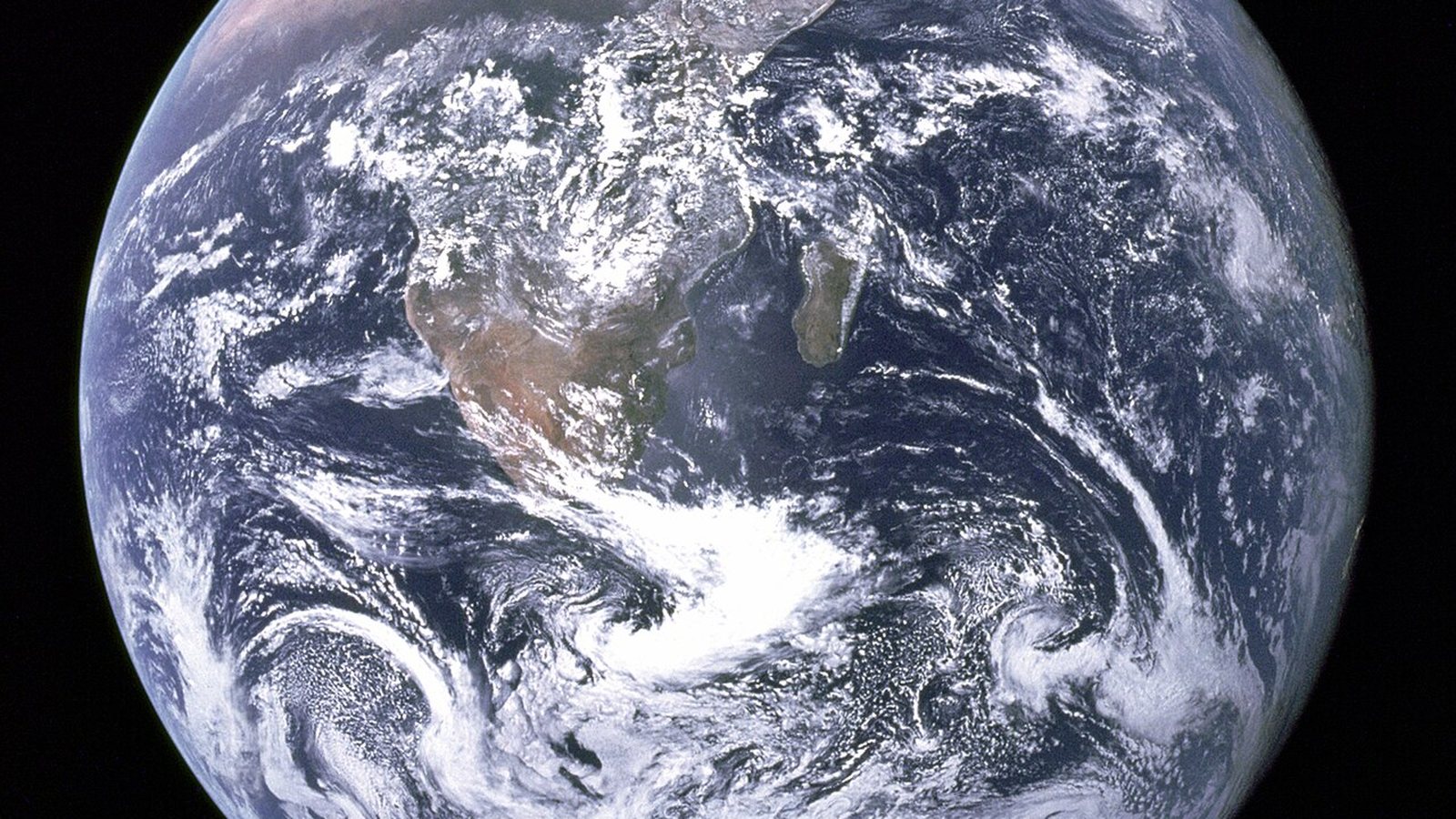
From a few tens of thousands of kilometers out, Earth stops looking like a map and starts looking like a jewel. Oceans dominate. Continents shrink into shapes you half-remember from school. Clouds scribble weather across an entire hemisphere in a single glance.
The famous “Blue Marble” photograph — taken by the Apollo 17 crew in December 1972 — still does something quiet to the mind. There are no country lines. No city lights in that daylight frame. Just a wet, living world wrapped in a film of gas so thin that, drawn to scale, it would be thinner than the skin on an apple.
The picture was taken on Dec. 7, 1972, by the crew of Apollo 17, Eugene Cernan, Ronald Evans and Harrison Schmitt, as they coasted toward the Moon. NASA’s catalogue lists it as AS17-148-22727. It runs from the Mediterranean to Antarctica, and NASA notes it was the first time an Apollo trajectory made it possible to photograph the south polar ice cap. Africa and the Arabian Peninsula are clear; most of the southern hemisphere is under cloud.
The atmosphere is almost nothing
Most of the air you breathe sits below about 10–15 kilometers. Mount Everest scrapes near the top of that useful layer. Commercial jets cruise where the sky is already darkening toward black. Above that, pressure falls so quickly that human bodies fail without machines. The cosmos does not begin at some distant border. It begins a short elevator ride above your roof.
Put numbers on it. Earth’s average radius is 6,371 km. The line most often used for the edge of space, the Kármán line, sits 100 km up: 1.6 percent of the radius. Shrink Earth to a 30-centimetre classroom globe and everything below that line is a layer 2.4 millimetres thick. The International Space Station, at about 400 km, would orbit less than a centimetre above the surface of the globe. Even inside that thin layer, the air is lopsided: in the standard atmosphere model, about half of it by mass lies below 5.5 km, lower than many mountain peaks.
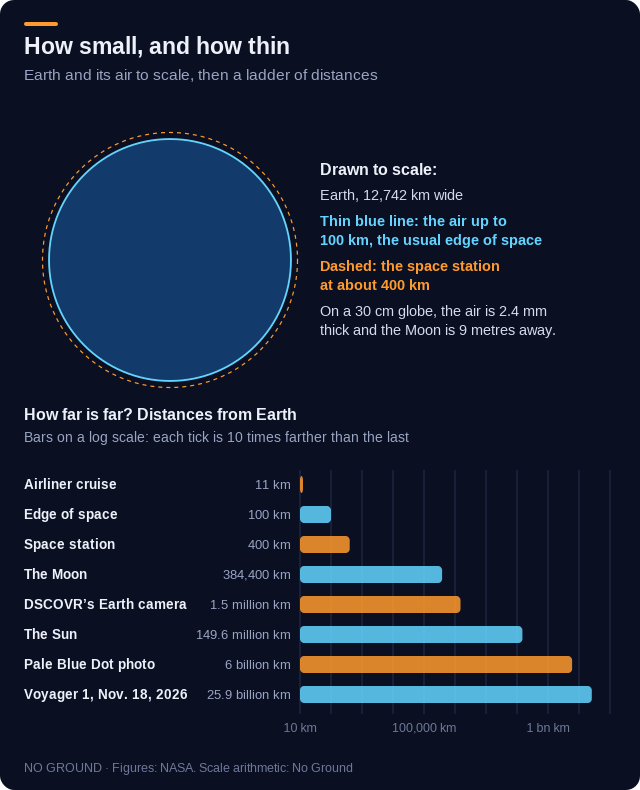
We do not live on a planet with space around it. We live in space — briefly sheltered by a soft blue shell.
Astronauts often describe a cognitive shift after seeing Earth this way: the overview effect. It is not mysticism. It is pattern recognition. When every war, harvest, and birthday party you know fits on one lit disk, scale rewrites priorities — at least for a while.
Compare that thin shell to the distances inside the Solar System and the feeling sharpens. The Moon is about 384,000 kilometers away — roughly thirty Earth diameters. Mars, even at a favorable approach, is tens of millions of kilometers farther. Voyager 1 has already crossed into interstellar space, still speaking in a whisper of watts. Today, Nov. 18, 2026, at 5:16 a.m. EST, NASA said it became the first human-made object one light-day from Earth, about 25.9 billion kilometres. A radio command now takes a full day to reach it. Against those numbers, the Blue Marble is less a postcard and more a reminder: every ecosystem we argue about shares one closed envelope.
Explore your sky tonightLive sky map for where you are: planets, the ISS and bright stars above your horizon.That is why Earth imagery remains political without needing a caption. A single disk makes scarcity visible. Fresh water, arable land, and breathable air stop being infinite backgrounds and become finite surfaces. You do not need a manifesto. You need a clear photograph and a quiet minute.
Three distances, three Earths
How Earth looks depends on how far away you are. From the space station, about 400 km up, astronauts do not see a ball. They see a curved horizon and a thin blue glow along its edge, with the ground sliding by at about 28,000 km/h. To see the whole planet at once, you have to go much farther.
From the Moon’s distance, about 384,000 km, Earth becomes a small, bright disc. The Apollo 8 crew photographed it rising over the lunar horizon on Dec. 24, 1968, the picture now called Earthrise. The Moon itself is slowly drifting away from us, by about 3.8 centimetres a year.
Today a NASA camera called EPIC watches Earth from about 1.5 million km away, on the DSCOVR spacecraft. It sits near a balance point between Earth and the Sun and takes pictures of the whole sunlit side, many times a day. And on Feb. 14, 1990, Voyager 1 turned its camera back from about 6 billion km. In that frame, the Pale Blue Dot, Earth is smaller than a single pixel.
What the photo still teaches
Satellites now stream Earth imagery constantly. Weather models ingest it. Climate science depends on it. Yet the old Apollo frame retains a power modern dashboards lack: stillness. One image. One orbit. One chance to notice that home is finite.
Diameter: about 12,742 kilometers. Mass: roughly 5.97 × 10²⁴ kilograms. Age: about 4.5 billion years. Those numbers feel abstract until you place them next to a human lifespan, or the width of a city block. Then the marble becomes personal again — not smaller, exactly, but closer.
There is one more way to feel the thinness. Just above the air, space is not gentle. In direct sunlight a spacesuit can face temperatures well above boiling on one side and far below freezing on the other, which we explain in how cold space really is. The shell that keeps all of that out is a few kilometres of breathable air.
Tonight, if the sky is clear, step outside. The same planet hangs under your feet. You are already in the picture. You always were.
No Ground.