 No Ground
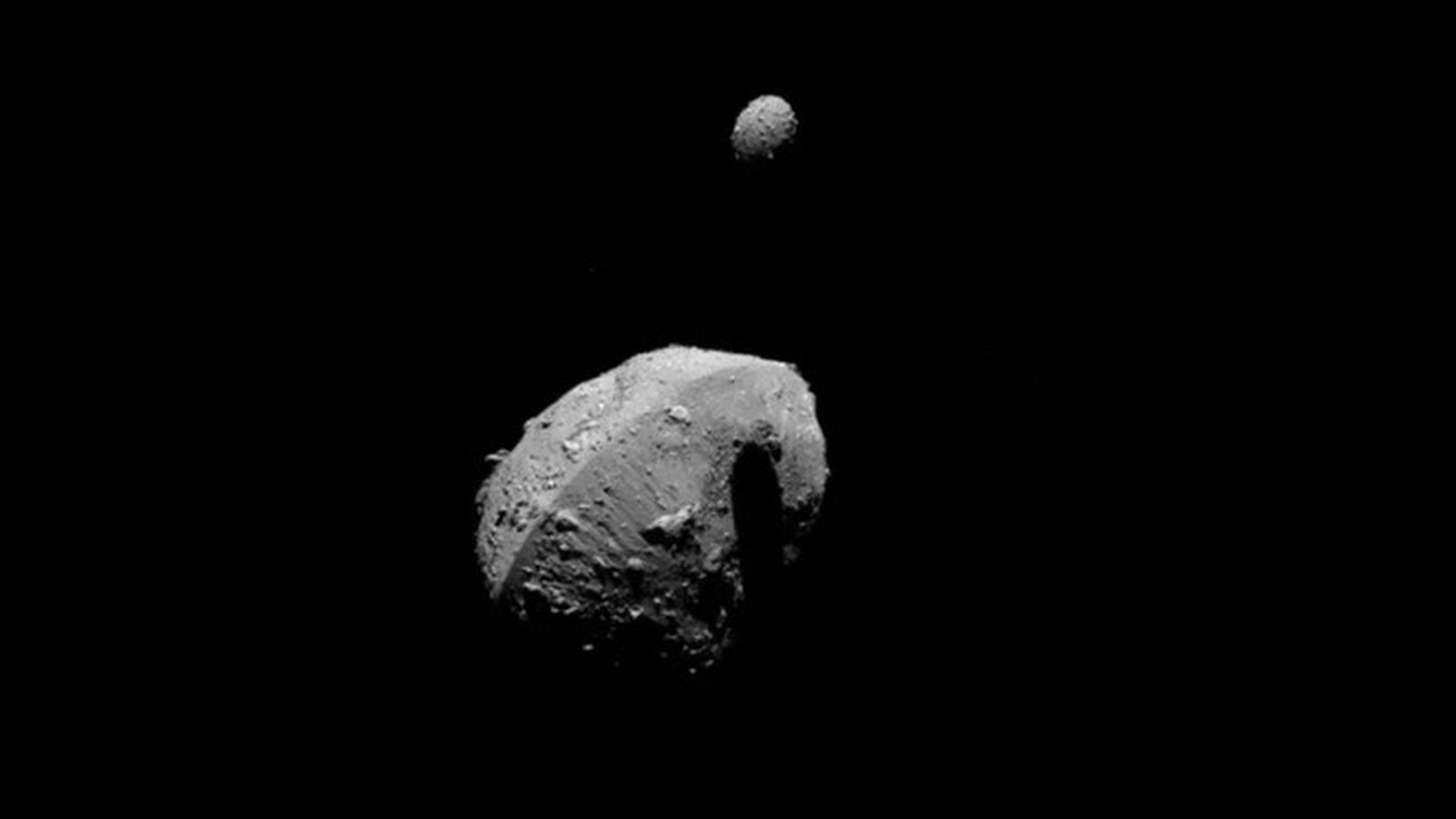
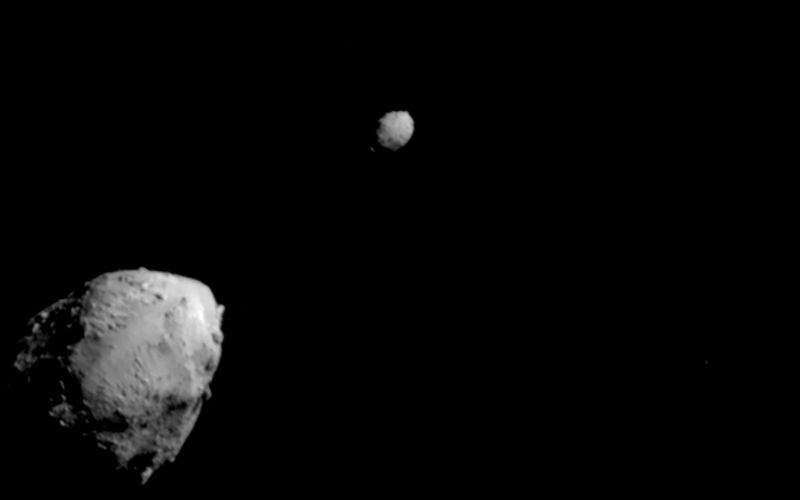
A spacecraft far from Earth has sent back a solar eclipse. Not the kind you watch from a backyard — one asteroid is casting its shadow across another.
The European Space Agency (ESA) published the view on Monday, Nov. 23, 2026. It comes from the Hera mission, which has arrived at the Didymos pair of asteroids to inspect the aftermath of NASA’s 2022 DART impact. In the early monochrome picture, the smaller moonlet, Dimorphos, sits above a lumpy, boulder-strewn Didymos. A dark, rounded shadow stretches across part of the larger body’s surface, blotting out the Sun along that stretch of rock.
It is a simple geometry lesson, and a striking one. The same kind of alignment that darkens a town on Earth can happen on a pile of rubble only a few hundred metres wide.
The same mechanics, a much smaller stage
“Eclipses just like last summer’s total solar eclipse occur on asteroids as well, when they have a small moon like this one,” said Patrick Michel, Hera’s principal investigator and a director of research at CNRS / Observatoire de la Côte d’Azur, in ESA’s release. “Didymos and Dimorphos are subject to the same celestial mechanics as Earth and the Moon, but at a much smaller scale and lower gravity environment.
“So in principle someone could be sitting on Didymos and have the same kind of eclipse experience — although in practice sitting there would be very difficult because its gravity is so low and it is spinning very fast!”
The shadow looks large because Dimorphos is close. ESA says the moonlet orbits only about a kilometre from Didymos. Dimorphos is just 151 metres across, about the size of the Great Pyramid of Giza. Didymos is 730 metres across, a bit smaller than Dubai’s Burj Khalifa. At those sizes, a one-kilometre gap is a short hop, and the moonlet can throw a clear shadow onto its parent.
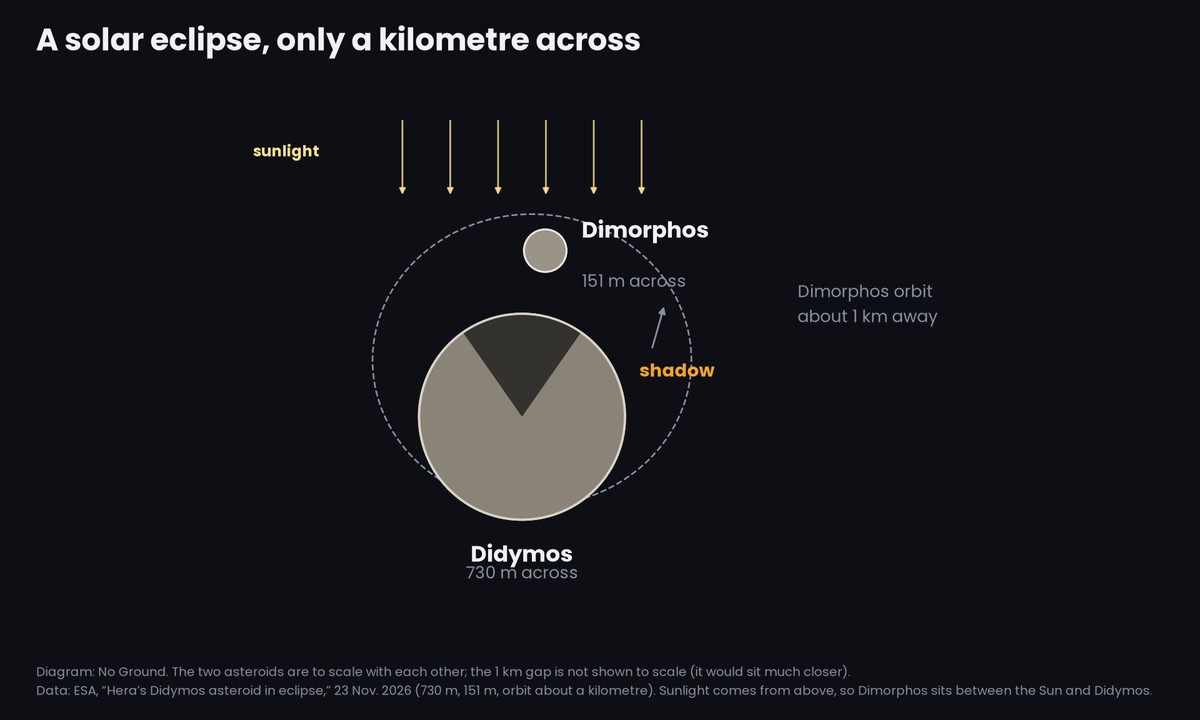
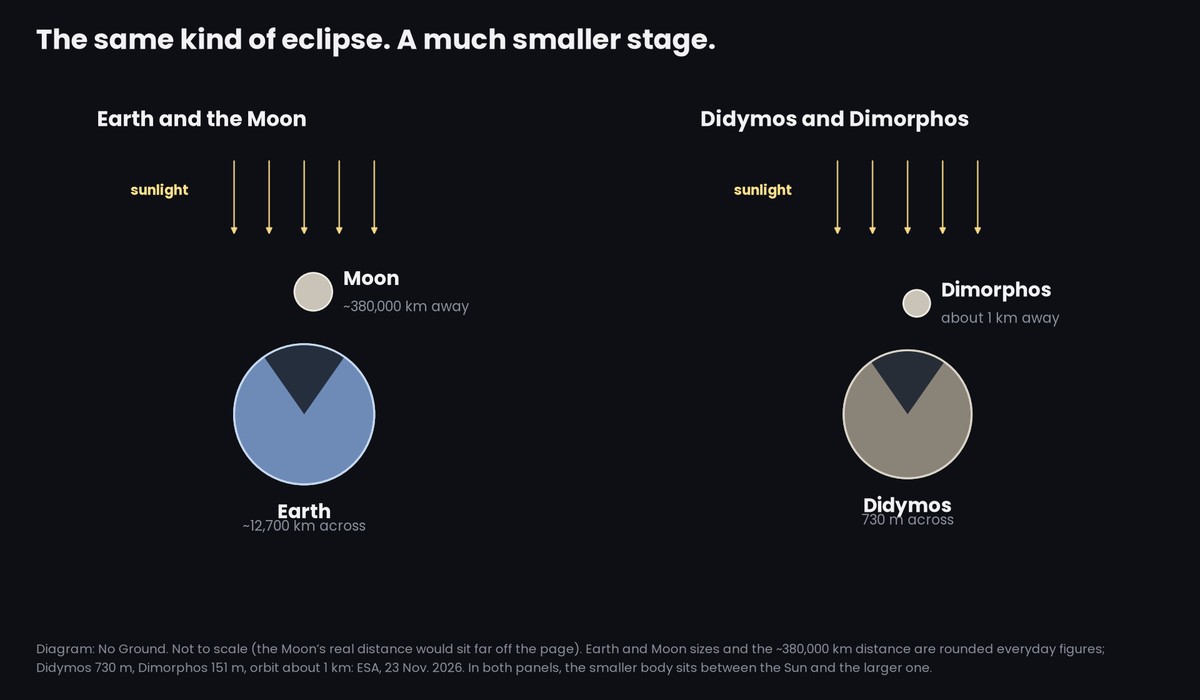
ESA’s page also gives gravity figures for the pair, but it repeats the name Dimorphos for both numbers, so we are not repeating those exact multiples here. The point Michel is making does not depend on the precise factor: this is an extremely low-gravity place, and it would be a lousy seat for an eclipse picnic.
The crash Hera came to inspect
Dimorphos is not a random moonlet. On Sept. 26, 2022, NASA’s DART spacecraft slammed into it on purpose, to see whether a kinetic impact could change an asteroid’s path. ESA’s Nov. 5 close-up release says the 580-kilogram spacecraft, moving at about 6.1 kilometres per second, shortened Dimorphos’s orbit around Didymos by 33 minutes, give or take a minute — a larger change than had been predicted. It was the first time a Solar System object had its orbit measurably changed by human action.
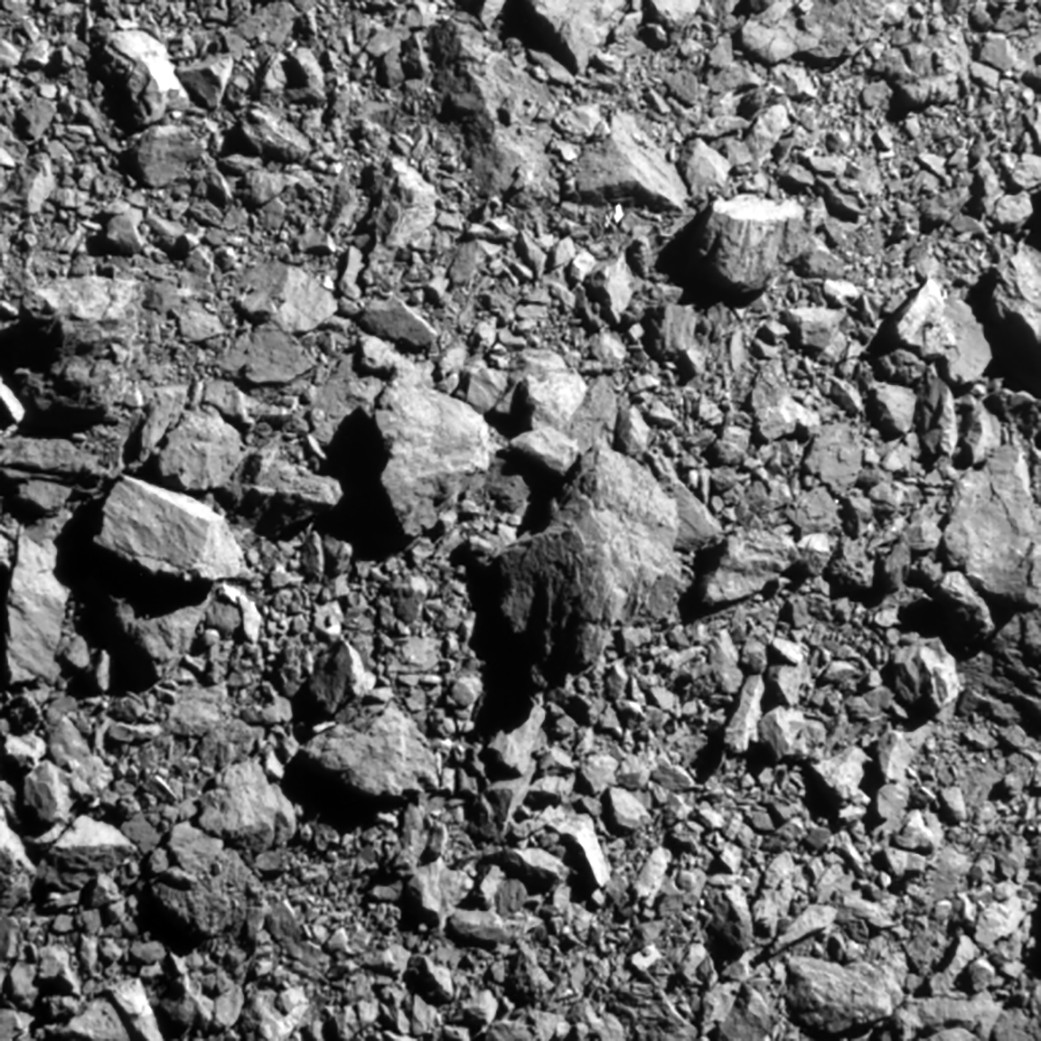
Hera’s job is the follow-up: a close-up “crash scene investigation,” in ESA’s phrase, so that one experiment can be turned into a technique we actually understand. If a hazardous asteroid ever needed a similar nudge, engineers would want to know how the rubble piled up, how the orbit shifted, and what the impact did to both bodies. That is why a clear picture of Didymos in Dimorphos’s shadow is more than a pretty geometry trick. It is a look at the system Hera is there to measure.
Explore your sky tonightLive sky map for where you are: planets, the ISS and bright stars above your horizon.We have been following this approach for weeks. In October, Hera closed in on the pair and made clear it cannot simply park in a tidy orbit the way a spacecraft can around a planet. It has to fly careful, slow passes. The new eclipse image is one of the early views from that work.
A navigation camera, used as a science camera too
ESA says the eclipse picture was acquired by Hera’s monochrome Asteroid Framing Camera, which the spacecraft uses both to navigate and to take science images. That is why the view is black-and-white. It is a real photograph from the spacecraft, not a painting, and it is an early one: ESA presented it as a preview ahead of a fuller image release. Even in this frame you can already see the character of the place. Didymos looks less like a smooth potato than a pile of boulders and ridges, with a sharp terminator where the shadow begins. Dimorphos is a smaller, equally irregular lump hanging above it.
Hera reached the system earlier this month. A Nov. 5 ESA release showed a first close-up from about 60 kilometres away, with Didymos lit and most of Dimorphos hidden in shadow. That earlier picture already hinted at how different the “far” side of Didymos looks from the side DART saw, with boulders, craters, and what might be grooves or ridges. The new eclipse image is the first from Hera, at least in the images released so far, in which the moonlet’s shadow is clearly painted across Didymos itself.
Scientists will want more than a pretty silhouette. Material thrown off Dimorphos by the DART impact may have reached Didymos across that one-kilometre gap. ESA’s Michael Kueppers, the Hera mission scientist, said as much in the Nov. 5 release: some of the features on Didymos may come from that transport of debris, and the team has “exciting work ahead” to sort it out. A crisp shadow is a start. A full map of both bodies is the point.
More close-ups are scheduled for later today
ESA has been clear that the most detailed look at the transformed moonlet is still to come. The agency is holding a livestream starting at 19:45 CET on Wednesday, Nov. 25 — 1:45 p.m. ET — on ESA WebTV and the ESA YouTube channel, where the Hera team is scheduled to share the first close-up images of the object DART changed. This article is going out before that event. The pictures in it are only the ones ESA has already released.
If the new images appear as planned, they should show Dimorphos itself in much more detail than this early eclipse frame. Until then, the shadow on Didymos is the sharpest reminder that Hera is no longer approaching a pair of faint dots. It is already inside the system, close enough to watch one rock eclipse another.
A small stage, and a useful one
Planetary defence is often described in abstract terms: kinetic impactors, orbit periods, “if we ever need to.” This photograph makes the scale personal. Two irregular bodies, a kilometre apart, line up with the Sun and produce a shadow you can see. The physics is familiar. The setting is not.
Hera is also a reminder that arrival is a process, not a single moment. The same week that Europe and Japan’s BepiColombo slipped into orbit around Mercury, Hera has been working at a very different target: two small, weakly held piles of rock. Getting there is not the same problem as climbing out to Mars, but the patience is similar. You spend years crossing the Solar System so that, one day, a camera can catch a shadow in the right place.
The eclipse will happen again. Dimorphos keeps going around. What will not be routine, if Hera does its job, is our understanding of what DART really did to that little moon — and how to do something like it again, on purpose, if we ever have to.