 No Ground
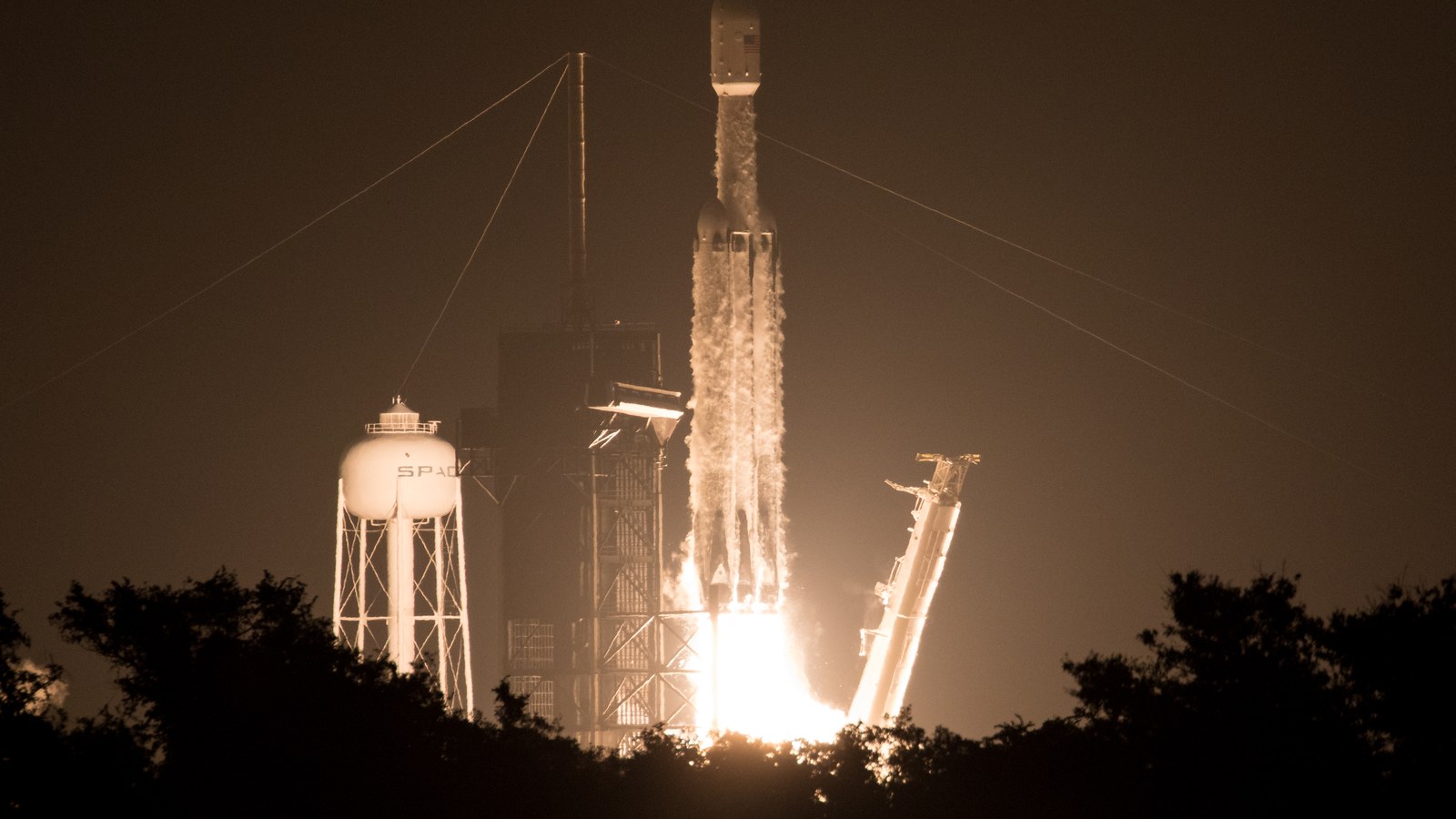
Update — Oct. 2, 2026: SpaceX’s Falcon Heavy launched the classified NROL-97 mission for the U.S. National Reconnaissance Office at 11:54 p.m. ET on October 1, 2026, from Launch Complex 39A (LC-39A) at NASA’s Kennedy Space Center in Florida. SpaceX later confirmed that both side boosters returned to Cape Canaveral Space Force Station and landed at Landing Zones 1 and 2 (LZ-1 and LZ-2).
Three cores. One classified NRO payload. A midnight Florida sky — and two boosters home to the Cape.
What launched — and what we don’t know
NROL-97 is a national-security mission. The payload itself remains classified, and No Ground is not inventing details about what rode inside the fairing. What is public: this was the first time the NRO flew on a Falcon Heavy, after more than twenty successful Falcon 9 launches for the agency. Mission coverage described a northeasterly departure from Florida’s Space Coast.
SpaceX’s own mission page framed the flight simply: Falcon Heavy lofted NROL-97 from pad 39A, then brought the two side boosters back to LZ-1 and LZ-2. An official SpaceX social post put it even shorter: “Falcon Heavy launches NROL-97 from pad 39A in Florida.”
Boosters, landings, and a busy SpaceX day
Falcon Heavy flies with three first-stage cores — two reusable side boosters flanking a center core. SpaceX said the side boosters on this mission were making their second and fourth flights; their prior work included missions such as GOES-U, Viasat-3 F3, and NASA’s Nancy Grace Roman Space Telescope. Reporting after liftoff identified the side boosters as B1104 and B1072, with a brand-new center core (B1106) expended on the flight — a standard heavy-energy profile when the customer needs every bit of performance.
Explore your sky tonightLive sky map for where you are: planets, the ISS and bright stars above your horizon.Minutes after liftoff, both side boosters touched down at LZ-1 and LZ-2, sending sonic booms across parts of East-Central Florida — exactly the recovery plan SpaceX had advertised. NROL-97 closed a packed calendar day for SpaceX: NASA’s Crew-13 crew launch from Florida that morning, the Transporter-18 rideshare from Vandenberg in the afternoon, then Falcon Heavy from 39A near midnight.
How a Falcon Heavy flight unfolds
Falcon Heavy is, in effect, three Falcon 9 first stages strapped side by side, with one upper stage on top. Together the three cores carry 27 Merlin engines that produce more than 5 million pounds of thrust at liftoff, about the same as eighteen 747 airliners, according to NASA’s launch services program. Fully expendable, it can carry up to 63,800 kilograms (140,660 pounds) to low Earth orbit.
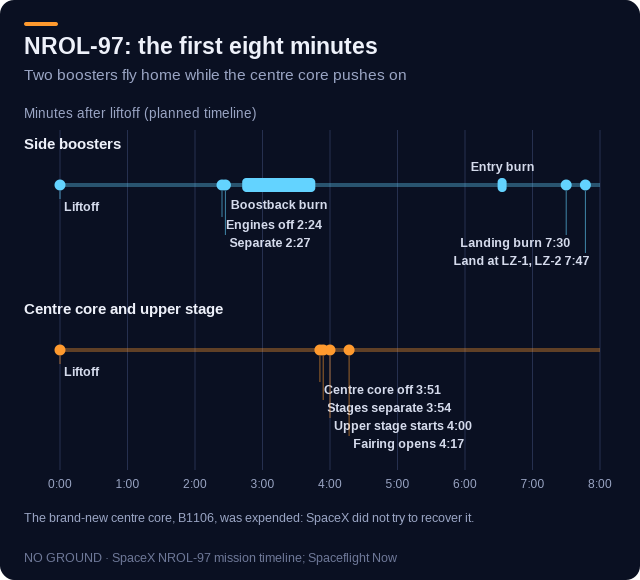
For the first two and a half minutes all 27 engines fire together. Then the flight splits. SpaceX’s published timeline for NROL-97 had the two side boosters shutting down at 2 minutes 24 seconds and separating three seconds later. Each then flipped around and fired its engines in a “boostback” burn to reverse course toward Florida, followed by a short entry burn to slow down as it fell back through the thicker air, and a final landing burn. Touchdown was planned for 7 minutes 47 seconds after liftoff, on the Landing Zone 1 and 2 pads at Cape Canaveral, and the descent produced the sonic booms heard along the coast.
The centre core keeps going. In SpaceX’s timeline it shut down at 3 minutes 51 seconds, separated from the upper stage three seconds later, and the upper stage’s single engine lit at the four-minute mark. The nose cone, or fairing, came off at 4 minutes 17 seconds. Because the centre core is much higher and faster by the time it lets go, it needs far more propellant to come back. For NROL-97, Spaceflight Now reported that the brand-new centre core was expended, meaning SpaceX did not try to recover it.
Reusing boosters is now routine for SpaceX on Falcon rockets. The company is trying to go much further with Starship, catching even the upper stage, as we reported in SpaceX caught a Starship from orbit.
A pad with a long history
Launch Complex 39A was built for NASA’s Apollo program. Apollo 11 left for the Moon from this pad in July 1969, and it was later rebuilt for the space shuttle, which first flew from 39A in 1981. After the shuttle retired, NASA signed a 20-year agreement in 2014 for SpaceX to operate and maintain the pad at its own expense. The Smithsonian’s National Air and Space Museum dates Launch Complex 39’s “baptism-by-fire” to the first Saturn V launch, in 1967, and notes that the first shuttle launch and the 23 after it all left from pad A. So when Falcon Heavy lit its 27 engines just before midnight on Oct. 1, it was standing on the same patch of Florida coast that sent the first astronauts to the Moon.
Falcon Heavy also has its own history there. Its first flight, on Feb. 6, 2018, also lifted off from 39A and sent a Tesla Roadster into orbit around the Sun, and at the time it was the most powerful operational rocket in the world, NASA notes. NROL-97 was a very different kind of passenger: one whose purpose the public is not told.
Why the first NRO Falcon Heavy matters
Falcon Heavy is SpaceX’s heavy-lift workhorse for missions that need more energy than a single Falcon 9 can deliver. For the NRO, putting a classified payload on that vehicle expands the agency’s options after years of Falcon 9 flights — without telling the public what the satellite does. That silence is the point of classification. The open facts are still striking: a three-core rocket at Apollo-era pad 39A, two boosters back on land, and a national-security customer trusting Falcon Heavy for the first time.
The countdown is over. The side boosters are home. Whatever NROL-97 carries is now on its classified path — and that is as much as the public record allows.
No Ground. Stay curious.