 No Ground
Most of the solar system has had more than one visitor. Rovers have been rolling on Mars for years. Cassini spent 13 years orbiting Saturn. Jupiter has had a string of flybys and orbiters. Uranus has had one.
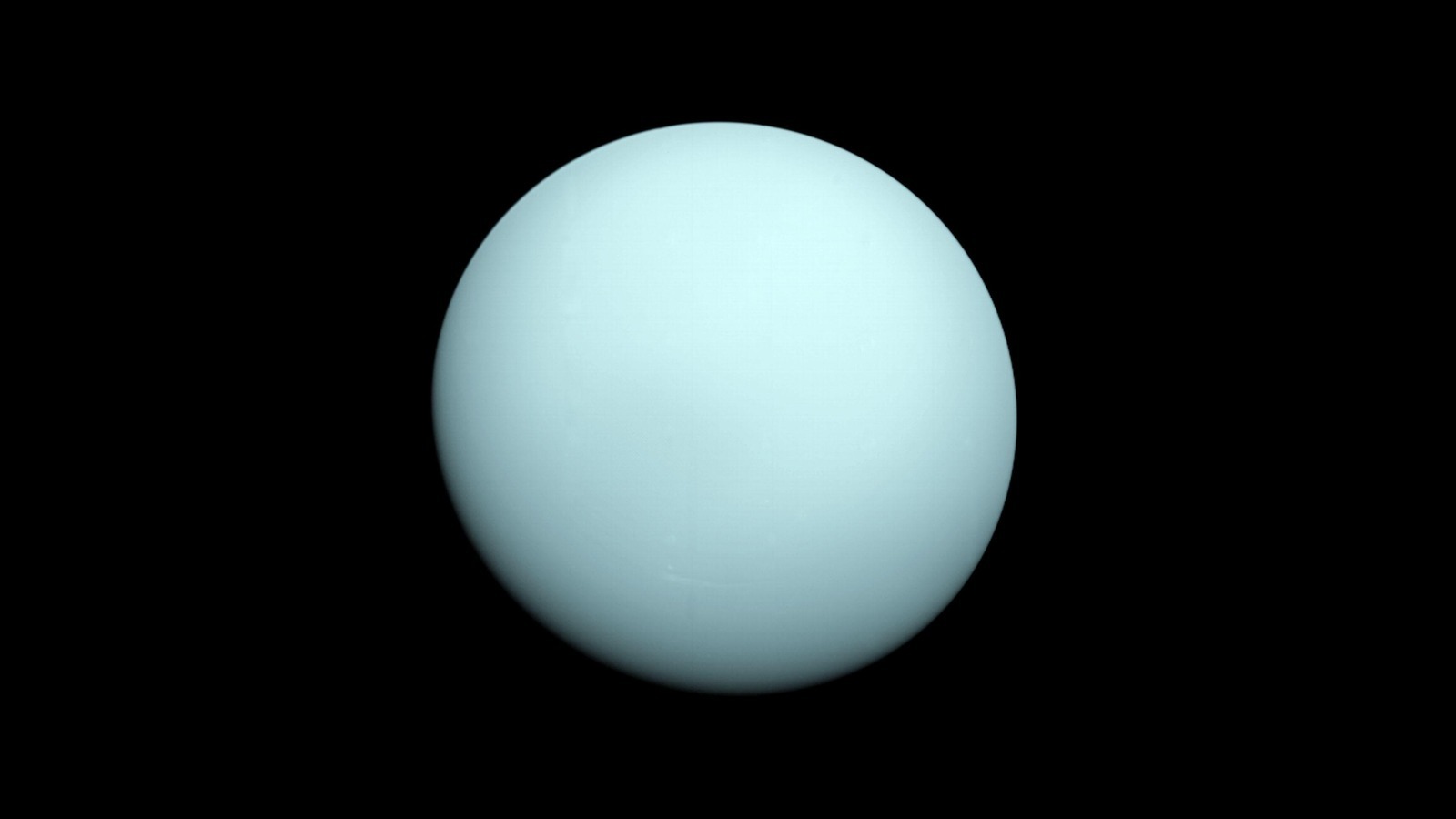
NASA’s Voyager 2 flew past on Jan. 24, 1986, coming within about 50,600 miles of the cloud tops. In just six hours, it gathered much of its critical information about the planet, including its rings and moons. Forty years later, it is still the only spacecraft that has ever visited. The rest of what we know comes from the Hubble Space Telescope and large telescopes on Earth.
The only close look lasted a few hours
Voyager 2 launched on Aug. 20, 1977, a little more than two weeks before its twin, Voyager 1. After flying past Jupiter in 1979 and Saturn in 1981, it was sent on to Uranus — a journey NASA says took about 4.5 years. It is still the only spacecraft to visit Uranus and Neptune, and the only one to study all four giant planets at close range.
Closest approach came at 17:59 Universal Time on Jan. 24, 1986, at a range of about 50,640 miles (81,500 kilometers) from the cloud tops. NASA’s Uranus exploration page rounds that to about 50,600 miles. Because Uranus is tipped on its side, the encounter was more like aiming at a bull’s-eye than flying along the planet’s equator, and the close-up work had to be packed into a few hours. The Voyager 2 mission page says the spacecraft had only about 5.5 hours of close study; the exploration page says it gathered much of its critical information in just six hours.
During that pass, Voyager 2 discovered 10 new moons and two new rings. It also found a magnetic field stronger than Saturn’s, tipped and offset from the planet’s center, and it flew within about 17,560 miles of Miranda, the closest it had come to any world on the trip so far.
One later spacecraft did cross Uranus’s path. NASA’s New Horizons, bound for Pluto, crossed the orbit of Uranus on March 18, 2011, but it did not fly by the planet or take images of it. A crossing is not a visit.
Voyager 2 is now in interstellar space. Its twin, Voyager 1, is now one light-day from Earth.
A planet that rolls around the Sun like a ball
Uranus is the seventh planet from the Sun and the third-largest by diameter. It is 31,763 miles (51,118 kilometers) across — four times wider than Earth. On average it sits about 1.8 billion miles (2.9 billion kilometers) from the Sun, or about 19 times farther than we are. At that distance, sunlight takes 2 hours and 40 minutes to arrive.
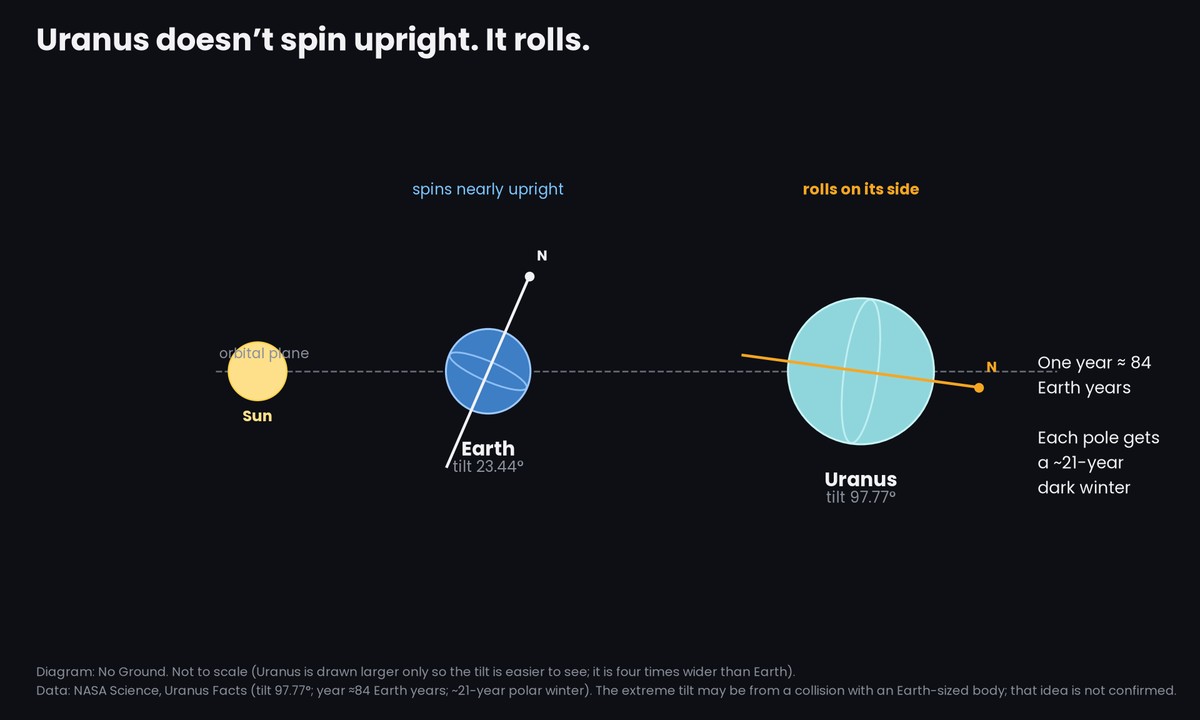
The ice giant is famous for its tilt. Uranus is the only planet whose equator is nearly at a right angle to its orbit, with a tilt of 97.77 degrees. NASA says that unique lean makes Uranus appear to spin sideways, “orbiting the Sun like a rolling ball.” This may be the result of a collision with an Earth-sized object long ago; scientists are not sure.
The tilt gives Uranus the most extreme seasons in the solar system. One trip around the Sun takes about 84 Earth years (30,687 Earth days), so each pole spends about 21 years in darkness — a winter that lasts nearly a quarter of a Uranian year — while the Sun hangs over the other pole. Uranus also rotates in the opposite direction from most planets, the same unusual backward spin seen on Venus. One day there lasts about 17 hours.
Like Neptune, Uranus is an ice giant. NASA says most of its mass — 80% or more — is a hot, dense fluid of water, methane and ammonia around a small rocky core. There is no solid surface to land on. Methane in the atmosphere absorbs the red part of sunlight and reflects the rest, which is why the planet looks blue-green.
What Voyager 2 found at Uranus
When Voyager 2 arrived, astronomers already knew of five moons and a set of dark rings first spotted in 1977. The flyby added 10 moons and two rings. Today NASA lists 28 known moons, named for characters in the works of William Shakespeare and Alexander Pope, and 13 faint rings.
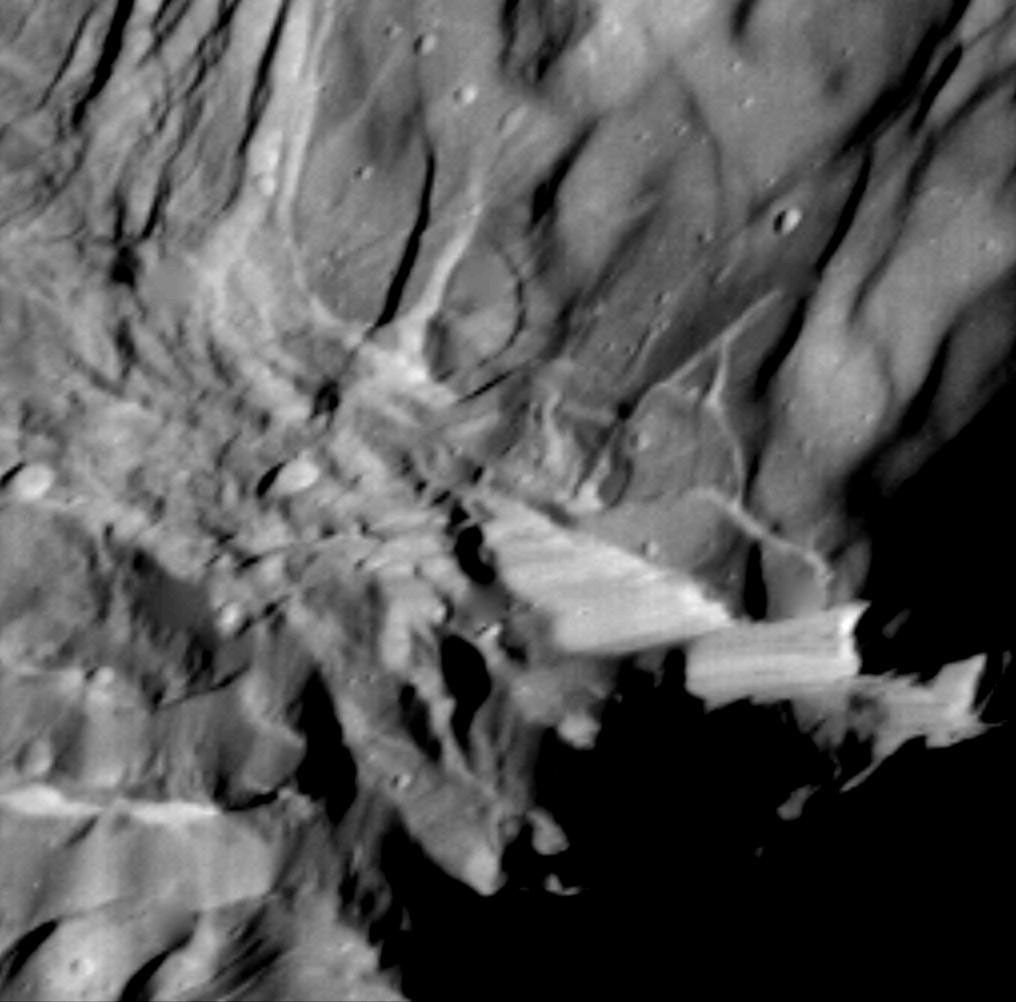
The inner nine rings are mostly narrow and dark grey. Of the two outer rings, later photographed by Hubble, one is reddish and the other is blue, a little like Saturn’s E ring. The moons were a surprise of their own. Miranda, especially, looks like a world that was broken and put back together, with huge ridges, valleys and sharp cliffs.
Voyager 2 also found that Uranus’s magnetic field is irregular: NASA’s facts page says it is tipped nearly 60 degrees from the planet’s spin axis and offset from the center by about one-third of the planet’s radius. (The Voyager 2 mission page gives the tilt as 55 degrees.) Behind the planet, the magnetic tail is twisted into a long corkscrew. In the images, Uranus itself looked generally featureless, with only a few distinct clouds.
Find Uranus in your sky tonightIt’s faint — the live sky map shows where to look from where you are.It may have caught Uranus on a weird day
For decades, that one flyby shaped how scientists thought about Uranus’s magnetic bubble, or magnetosphere. The data showed intense electron radiation belts, second only to Jupiter’s, but almost no plasma filling the rest of the bubble. The five major moons should have been feeding the magnetosphere with water ions, as icy moons do elsewhere. They looked inert.
A 2024 study led by Jamie Jasinski of NASA’s Jet Propulsion Laboratory, published in Nature Astronomy, offers a different explanation: timing. The team went back to Voyager 2’s solar-wind measurements and found that the spacecraft arrived while Uranus’s magnetosphere was in an unusually compressed state. The paper estimates that state is present less than 5% of the time. “The spacecraft saw Uranus in conditions that only occur about 4% of the time,” Jasinski said in a NASA release.
“If Voyager 2 had arrived just a few days earlier, it would have observed a completely different magnetosphere at Uranus,” he said. The paper found that a few days earlier, the pressure of the solar wind would have been about 20 times lower.
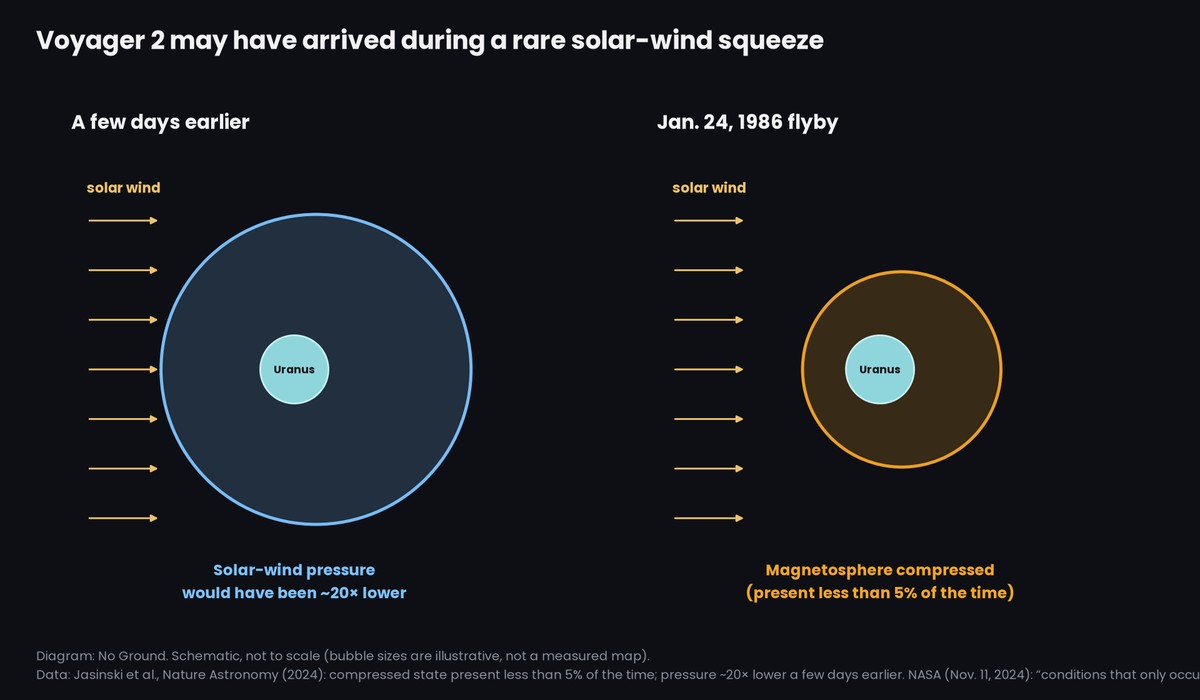
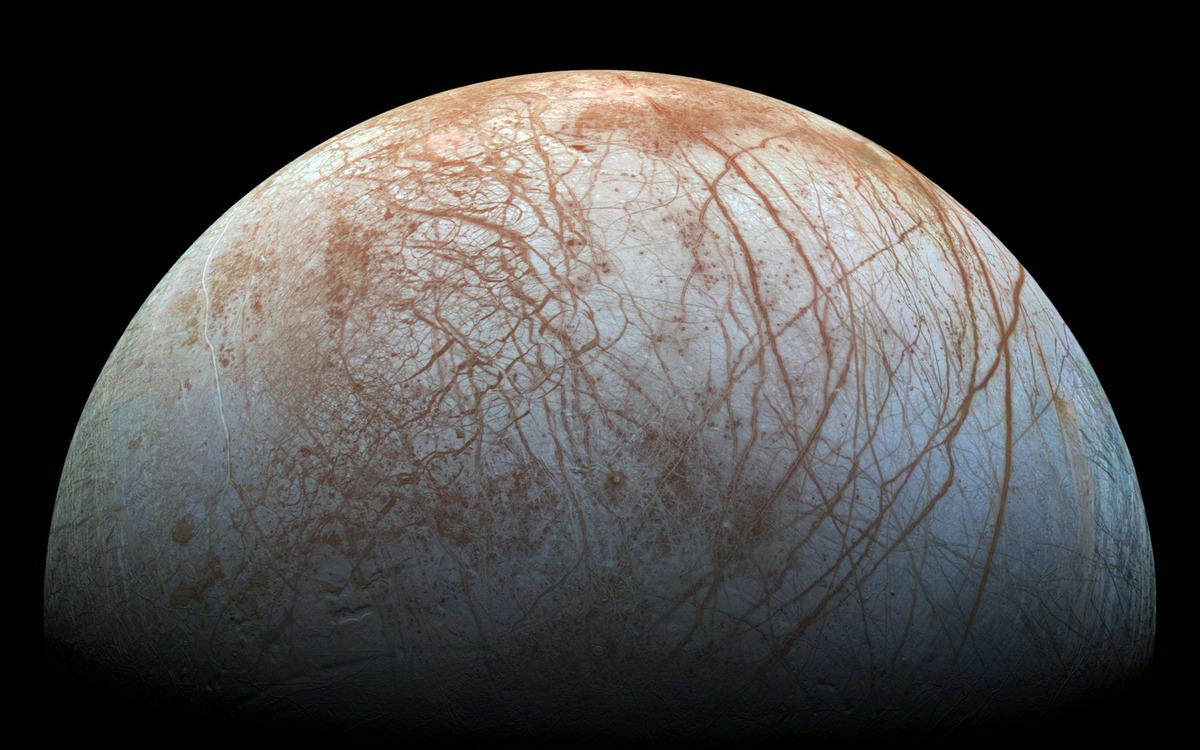
The researchers suggest that the solar-wind squeeze could have pushed plasma out of the system and briefly intensified the radiation belts. If that is right, Uranus’s magnetosphere may not be as extreme as the 1986 snapshot made it look. It also leaves the door open for the major moons: with an explanation for the missing plasma, the team says it is plausible those moons have been releasing ions all along, and that some could be geologically active after all. That is a possibility, not a proof. Scientists already know that some icy moons, including Jupiter’s moon Europa, hide saltwater oceans beneath their crusts.
Why scientists want to go back
A few hours of data, taken under unusual conditions, is a thin foundation for an entire planet. Since 1986, Hubble and ground-based telescopes have shown Uranus can be more active than Voyager’s pale, quiet portraits suggested, especially around equinox. But they cannot replace a spacecraft that stays.
In 2022, the National Academies’ Planetary Science and Astrobiology Decadal Survey for 2023–2032 named a Uranus Orbiter and Probe the highest-priority new Flagship mission to start in that decade. The concept would drop a probe into the atmosphere and spend years in orbit, studying the planet, its lopsided magnetic field, its rings and its moons. NASA has said a flagship mission to Uranus will be a focus in the years to come. It has not been approved or given a launch date, and this article is not predicting one.
A return would also help scientists compare ice giants as a class — a kind of planet common around other stars, but barely explored in our own solar system. For now, the file on Uranus still rests heavily on one spacecraft, one flyby, and one possibly unusual day in 1986.
Bottom line: Voyager 2 is still the only spacecraft that has visited Uranus. Its 1986 flyby lasted a few hours and, according to a 2024 NASA-supported study, may have caught the planet during a rare solar-wind squeeze. A dedicated orbiter is the top new flagship priority in the latest U.S. planetary decadal survey, but no launch has been scheduled.