 No Ground
On 30 September 2026, the European Space Agency announced that Smile — the Solar wind Magnetosphere Ionosphere Link Explorer — is approved to begin science operations. The joint European–Chinese spacecraft had been declared ready on 23 September, after months of commissioning in orbit.
Smile launched on 19 May and reached its target science orbit on 20 June. Between arrival and the green light, European and Chinese teams deployed mechanisms, switched on units, checked every communications path, and worked through issues that only appear once a craft is flying.
Science ops are not a finish line. They are the start of watching Earth talk back to the Sun.
Four instruments, one question
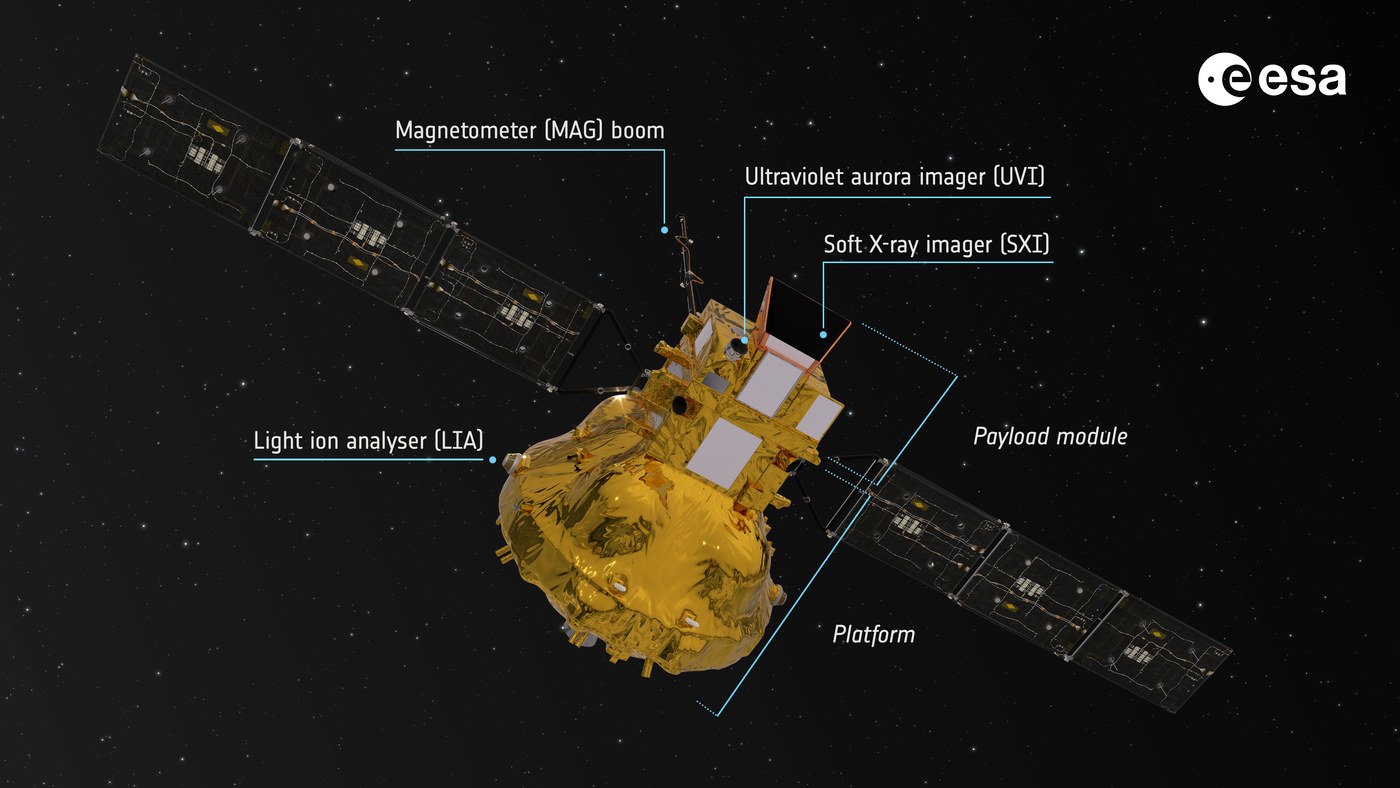
Smile carries four science instruments: the soft X-ray imager (SXI), the ultraviolet aurora imager (UVI), a magnetometer (MAG), and a light ion analyser (LIA). Together they are meant to show how solar storms and geomagnetic storms form — how charged particles from the Sun meet Earth’s magnetic field, light the auroras, and can stress electronics on and around the planet.
The mission is a partnership between ESA and the Chinese Academy of Sciences (CAS). ESA provides the payload module, the SXI instrument, the launcher, and assembly and test facilities; it also contributes to UVI and mission operations. CAS provides the other three instruments and the spacecraft platform, and leads operations in orbit.
A long orbit for a wide view
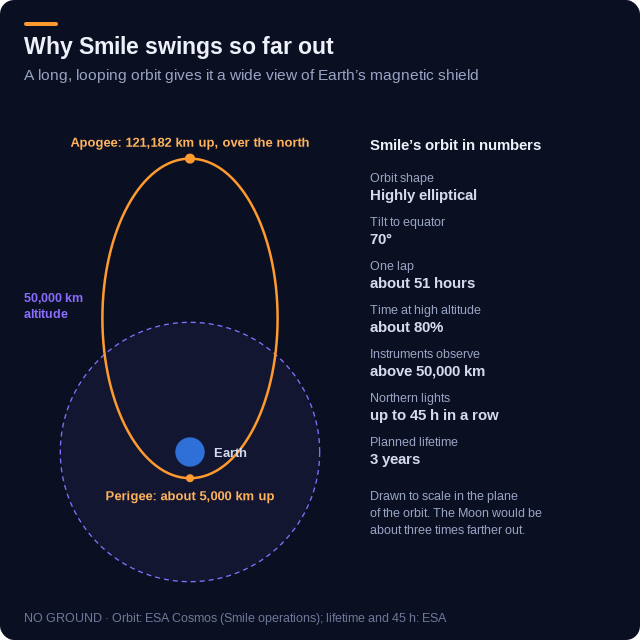
To photograph something, you need to stand back from it. Earth’s magnetic shield is enormous, so Smile does not circle close to the planet like most satellites. ESA’s mission documents describe a highly elliptical orbit, tilted 70 degrees to the equator, that dips to about 5,000 kilometres above Earth and then swings out to 121,182 kilometres, about a third of the way to the Moon. One lap takes about 51 hours.
The shape is a compromise. Smile has to climb high enough to see the outer edge of the magnetic field, yet still get a sharp view of the auroral oval, the ring of northern lights around the pole. The high point of the orbit sits over the northern hemisphere, and ESA says the spacecraft spends about 80% of its time at high altitude, which also keeps it out of the harsh Van Allen radiation belts for most of each lap. All four instruments work above about 50,000 kilometres.
Aurora in ultraviolet
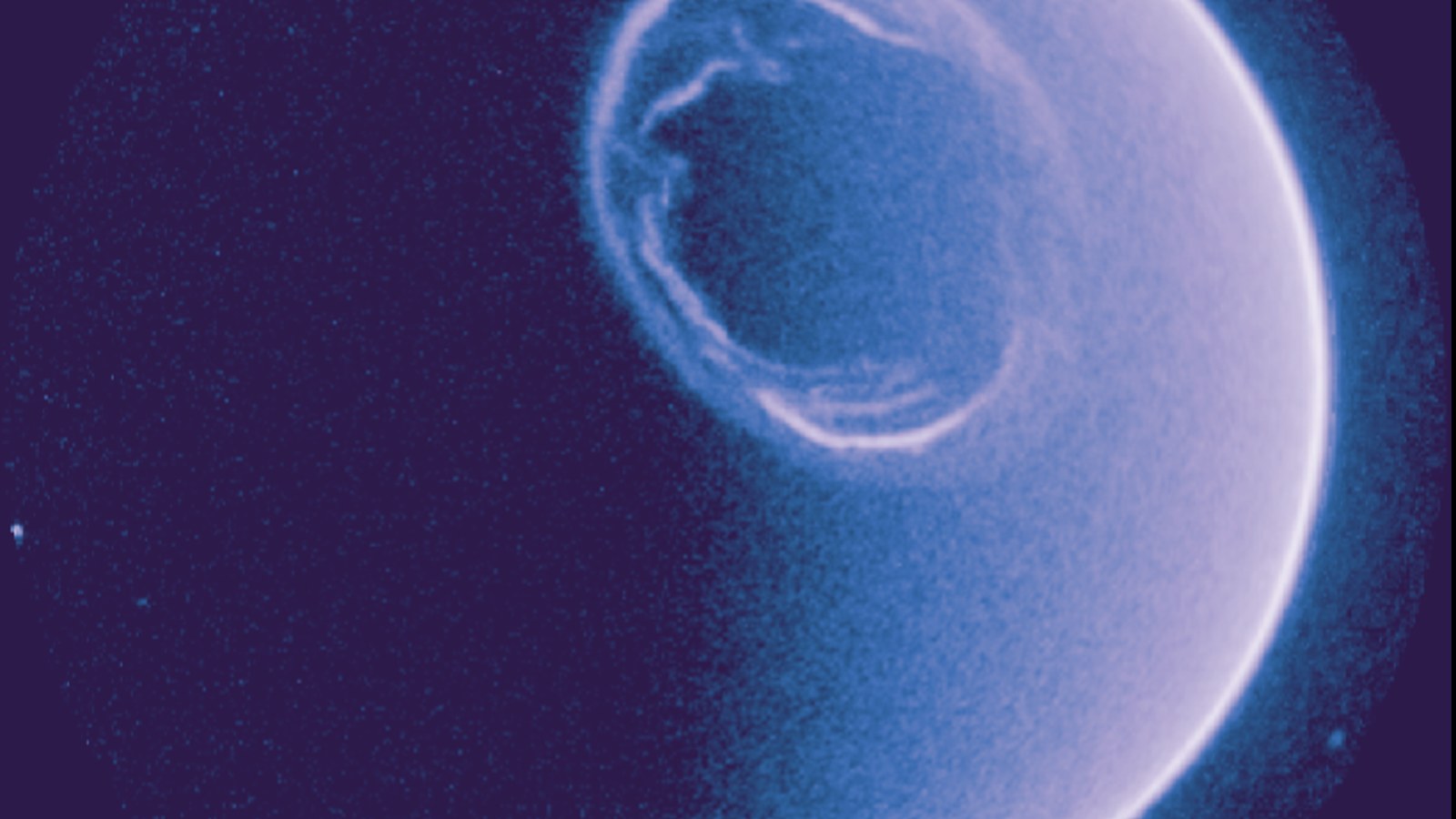
During commissioning, UVI delivered the first footage ESA has released from the camera: the full ring of northern lights around the North Pole in ultraviolet light — the first such full-ring UV view since 2008. UVI is now recording auroras for a record-breaking 45 hours at a time.
Explore your sky tonightLive sky map for where you are: planets, the ISS and bright stars above your horizon.That footage was taken on 24 July 2026, about two weeks after UVI was switched on. It shows activity in the auroral ring driven by a disturbance in Earth’s magnetic field when a rush of solar wind particles arrived.
“Smile is now approved to begin science operations,” said Professor Carole Mundell, ESA Director of Science, in ESA’s announcement. “This is a very important milestone — a true pleasure to announce — and I am sure our excellent collaboration will deliver ground-breaking data to scientists around the world.”
How X-rays can show an invisible boundary
The magnetic field itself cannot be photographed. What SXI is built to see is a side effect. The Sun blows out a constant stream of charged particles, the solar wind. Where Earth’s field holds that wind back, the field ends at a boundary called the magnetopause, with a standing wave in the solar wind, the bow shock, farther out. It is the same kind of shock wave that forms around some moving stars, like the one we wrote about in the Shrimp Nebula.
Earth’s atmosphere does not stop abruptly. Its thinnest outer layer, the exosphere, reaches out to these regions. When heavy, highly charged ions in the solar wind pass close to neutral atoms there, they can steal an electron, and in doing so they give off a faint glow of soft X-rays. ESA calls this solar wind charge exchange. The glow is brightest where solar wind piles up against the field, so an X-ray camera looking from far enough away should see the outline of the magnetopause, the bow shock and the cusps, the two funnels near the poles where solar wind can leak in. ESA’s XMM-Newton space telescope showed the technique works.
That is why SXI matters so much. Until now, scientists have measured the boundary mainly where individual spacecraft happened to cross it, one point at a time. A picture of the whole shape changing as a solar storm hits would be new. SXI was built by the University of Leicester with UCL’s Mullard Space Science Laboratory and other partners.
SXI: working, with a stray-light puzzle
Smile’s soft X-ray imager — a key European contribution — has also been switched on and has taken first images. Early test frames pointed at distant supernova remnants (including Cassiopeia A) to confirm the camera behaves as expected.
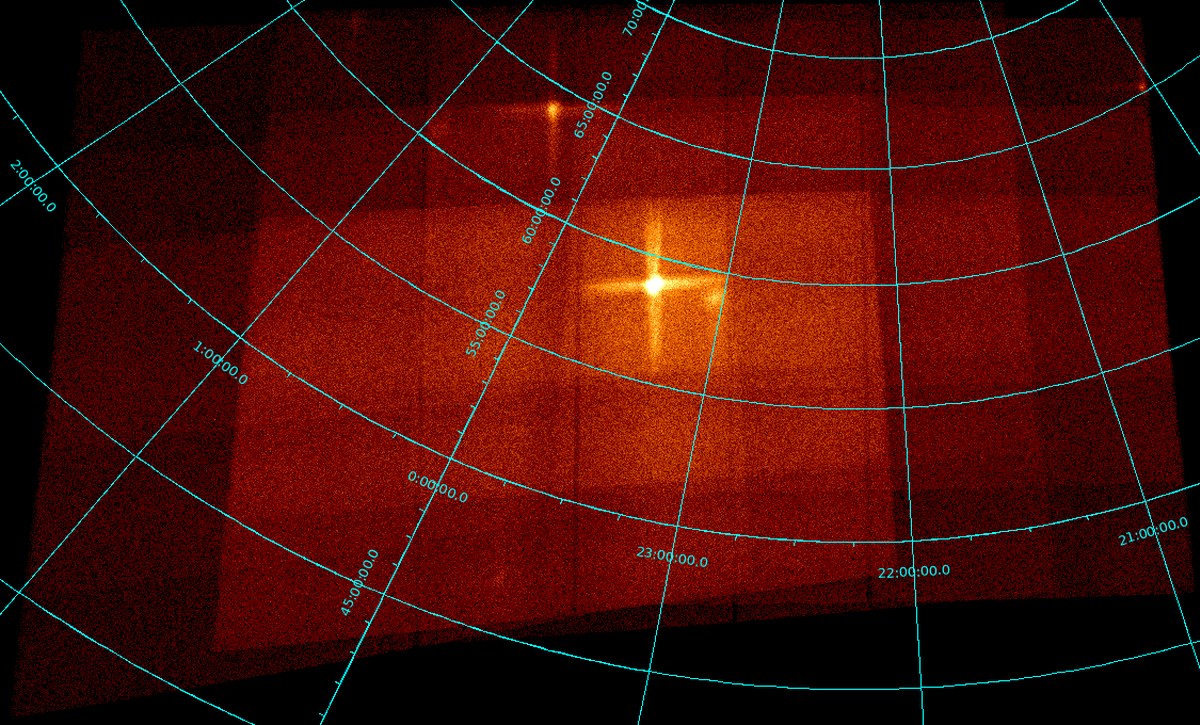
Pointed toward Earth, though, SXI currently sees too much unwanted stray light. Teams are changing settings and uploading software updates; the instrument’s design can be adjusted remotely. As Smile’s pointing moves farther from Earth and northern winter reduces polar light, the unwanted glow is falling naturally and is due to reach a minimum in mid-October — when SXI could take its first good image of the magnetopause or the northern polar cusp.
Until then, the mission’s quieter instruments are already listening. The solar wind keeps arriving. Earth’s magnetic field keeps answering. Smile is finally cleared to watch.
Why space weather forecasters care
ESA lists three open questions for Smile: how solar wind energy gets into the magnetic field on the dayside, what drives substorms, the sudden brightenings of the aurora like the one in UVI’s first footage, and how storms set off by coronal mass ejections develop. These are the events behind the alerts we explain in our guide to space weather alerts, and behind nights like the G3 storm of Oct. 10. Strong storms can disrupt GPS, radio communications and power grids, so seeing the whole system at once could improve forecasts.
No Ground. Stay curious.