 No Ground
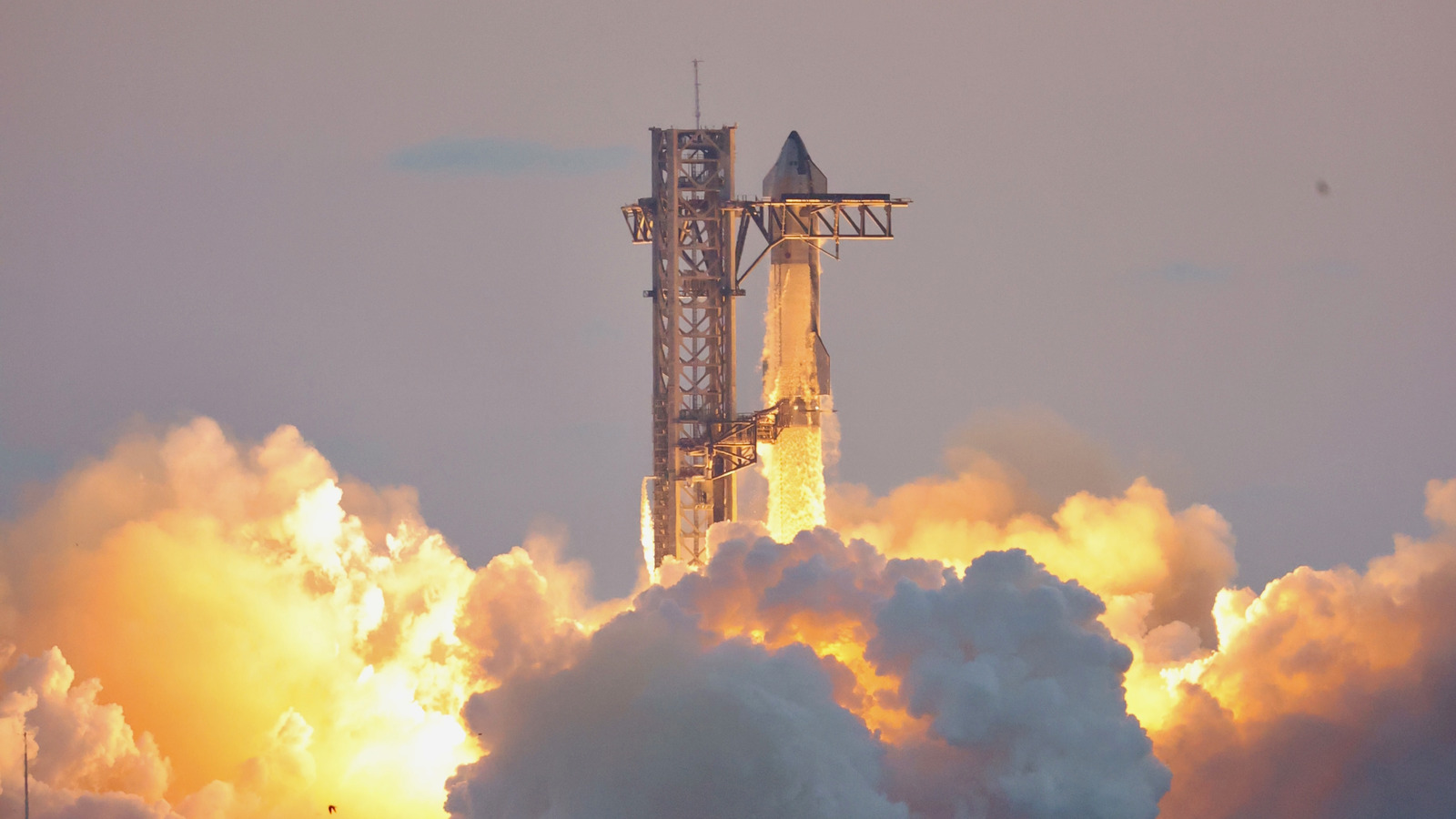
On Monday morning, the stainless stack at SpaceX’s Starbase in South Texas did what thirteen earlier integrated flights had not: it put Starship into Earth orbit. Liftoff came at 8:48 a.m. Eastern (7:48 a.m. local time) on Sept. 28, 2026. About twenty-five minutes later, Ship fired a single Raptor for a brief orbital insertion burn. Mission control’s call was simple — and historic: Starship was orbital.
The ascent was not clean. One of Ship’s six engines shut down early. Controllers briefly sounded ready to scrub the orbit attempt, then reversed course and pressed ahead. Super Heavy, after stage separation, returned for a controlled splashdown in the Gulf — also with engine hiccups on the way down. Drama on the way up; data on the way home.
Why this was the first orbital flight
Starship had flown 13 times before, and every one of those flights was deliberately suborbital. The ship went high and fast, but stayed on a path that would bring it down into the ocean even if its engines never fired again. SpaceX did that on purpose. A ship in a real orbit that cannot relight its engines could stay up for days and come down somewhere no one chose.
So the key test was a relight. On this flight the ship coasted on its suborbital path first, while controllers checked the engines it would need later. That was when Ship 41 was already down one of its vacuum engines, lost during the climb. SpaceX’s Dan Huot first told viewers that “the team has made the call not to commit to orbit,” according to Reuters, then reversed the call minutes later when engineers confirmed the three sea-level Raptors were healthy.
One of them relit for the orbit insertion burn at about 25 minutes after launch. NASASpaceflight timed it as a 95 m/s burn, a little over 1 percent of the ship’s speed, Ars Technica noted, and it put Ship 41 into an orbit of about 262 by 275 km, tilted 30.5 degrees to the equator.
Twenty-six Starlinks, for real
Orbit was only the first half of the day’s job. Ship carried 26 operational Starlink V3 satellites — the first batch of this generation meant to stay up, not fall back on a suborbital arc the way earlier V3 demos had in July. Deployment began roughly half an hour after liftoff and ran for about thirty minutes. SpaceX reported all 26 released, and contact made with each of them.
These satellites matter to SpaceX’s business. Each Starlink V3 weighs about 2 tonnes at launch, according to Ars Technica, and is too big to fit inside a Falcon 9 fairing. SpaceX says each one adds about 1 terabit per second of capacity, roughly 10 times the older satellites. Because of range-safety rules over populated areas, they were released into a low-inclination orbit, and over the following weeks they were to raise themselves to about 400 km.
Reaching orbit is a milestone. Leaving working satellites behind is a vocation.
Three of those Starlinks carried cameras pointed back at Ship — a quiet inspection of heat-shield tiles while the vehicle still had vacuum around it. Controllers later chose an early deorbit checkpoint: a few hours in space instead of the planned ~10-hour, multi-orbit cruise. The primary wins were already banked.
Explore your sky tonightLive sky map for where you are: planets, the ISS and bright stars above your horizon.Plasma, then fire on the Pacific
Reentry was Ship’s hardest yet — orbital energy, plasma sheath, then a flip and landing burn over a pre-planned Pacific site. The vehicle survived the scorching return and completed the controlled burn. The splashdown itself was harder than July’s Flight 13, when Ship settled so softly that SpaceX talked about hauling an intact vehicle home. This time the impact produced a massive fireball over the water. Partial integrity on the surface; a bright, expensive lesson in the difference between “controlled” and “gentle.”
That contrast matters. Soft water landings buy hardware back for autopsy. Hard ones still buy telemetry, tile performance, and engine-relight data — if the vehicle makes it through the blackout at all. Flight 14 did. Engine reliability on both stages remains unfinished business. Catching Ship in the tower’s arms is still ahead. So is orbital refueling.
Why this flight shifts the ground
For years Starship flights were suborbital essays in survival. Monday’s test closed a different loop: pad → orbit → payload → deorbit → atmosphere → ocean. NASA’s Artemis plans and SpaceX’s own cadence both lean on that loop becoming routine. One flight does not make it routine. It does prove the energy and the Pez-dispenser door can work on the same day.
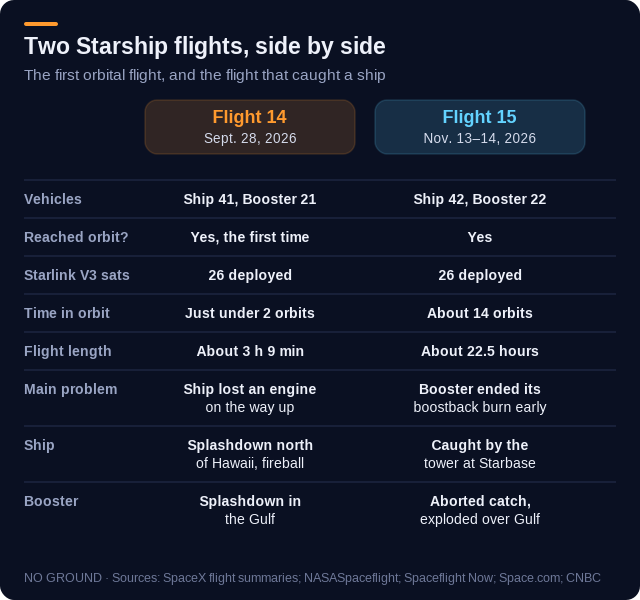
That deorbit burn was a first, too. SpaceX said a single sea-level Raptor relit to bring the ship out of orbit, and all three relit for the final flip and landing burn. NASASpaceflight timed the splashdown at 3 hours, 8 minutes and 30 seconds after launch, in the Pacific north of Hawaii, about three times longer than any earlier Starship flight.
What still had to be proven
Before this flight, the open questions were simple to list and hard to answer. Could the ship reach orbit, release a payload and still come home on purpose? Flight 14 answered yes. Could the engines be trusted? Not yet: the ship lost an engine on ascent and the booster lost several during its return. Could a ship come back from orbit and be caught by the tower, so it can fly again? That was still ahead.
The answer to that one came seven weeks later. On Flight 15, on Nov. 13 and 14, a ship stayed in orbit for about 14 laps and was caught by the tower’s arms at Starbase, a first. The booster on that flight was lost. The biggest step still to come is refuelling in orbit, which NASA’s plan for landing astronauts on the Moon depends on: the Starship lunar lander has to be filled up by other Starships before it leaves Earth orbit. Other rockets are still having trouble of their own; ULA’s Vulcan failed the day after the catch.
Watch the next stack for whether engine-out margins shrink. Watch whether Pacific recoveries get softer again. And watch whether those 26 V3 birds keep talking — the quiet proof that a test rocket has begun to behave like a launch system.
No Ground. Stay curious.