 No Ground
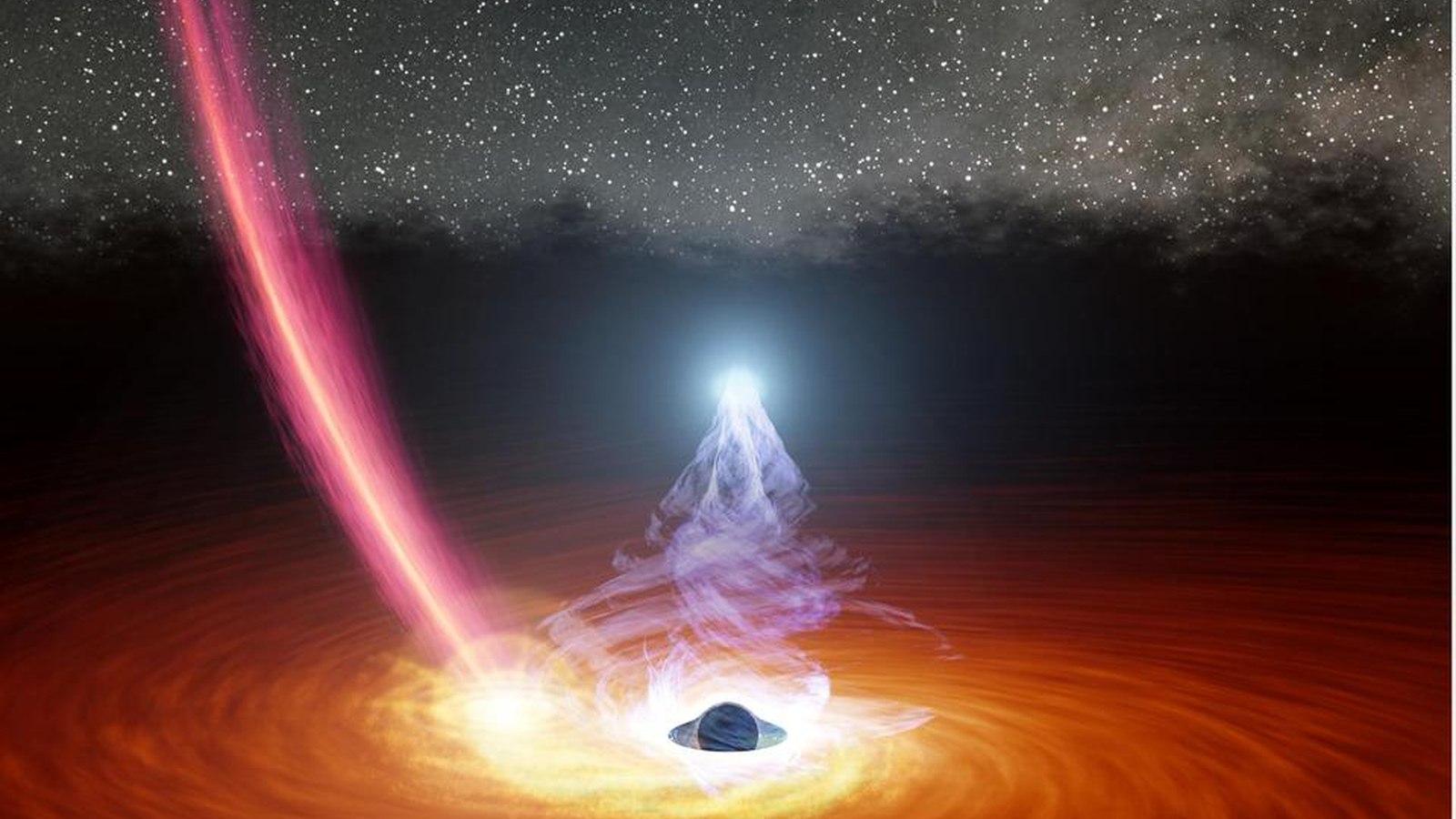
A black hole is not a cosmic vacuum cleaner roaming the neighborhood. It is a region where gravity has become so intense that, inside a boundary called the event horizon, even light cannot climb back out. Outside that boundary, physics remains ordinary — clocks tick, orbits work, coffee cools.
If the Sun were somehow replaced by a black hole of the same mass, Earth would continue on roughly the same yearly path. We would freeze in the dark, but we would not be slurped inward. Distance and mass still rule. Drama needs proximity.
Event horizon and singularity, in plain words
Two words do most of the work. The event horizon is not a surface. It is a boundary in space: outside it, light and matter can still escape if they move fast enough; inside it, every path leads further in. The singularity is what Einstein’s equations predict at the very centre, a point where density becomes infinite. Most physicists read that as a sign that the theory breaks down there, not as a description of something real. No one can observe it, because it sits behind the horizon.
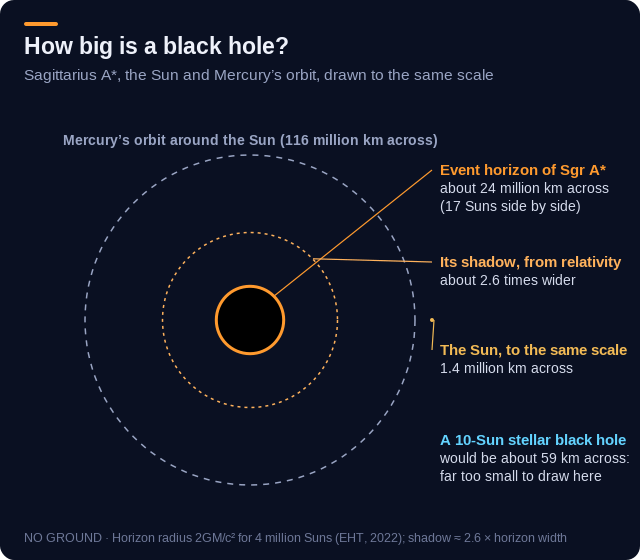
The size of the horizon depends only on the mass. For a black hole with the mass of the Sun, it would be about 3 kilometres in radius, roughly 6 km across. Squeeze Earth down to the same state and it would be about 9 millimetres in radius, the size of a marble. Double the mass and the horizon doubles in size.
That is also why the Sun will never become one. It is far too light. NASA expects it to swell into a red giant in about 5 billion years and end as a white dwarf, a dense, slowly cooling ember about the size of Earth.
Why galaxies care
Nearly every large galaxy appears to host a supermassive black hole at its center. Ours is called Sagittarius A*. It weighs about four million Suns, yet from about 27,000 light-years away it is a quiet neighbor — detectable in radio and infrared, not a daily threat.
Over cosmic time, though, these central engines help regulate how galaxies grow. Jets and winds from feeding black holes can heat surrounding gas, slowing the birth of new stars. The chemistry of the disk that made our Sun was written, in part, by earlier generations of stars — and by the violent bookkeeping of galactic centers.
In May 2022 the Event Horizon Telescope collaboration released the first image of Sagittarius A*. Eight radio observatories around the world were linked into one Earth-sized virtual telescope. The picture shows a dark centre, the black hole’s shadow, inside a ring of glowing gas whose light is bent by gravity. Seen from Earth, the team said, it is about the size a doughnut on the Moon would appear. The same team had already imaged M87*, a black hole about 6.5 billion times the mass of the Sun in a galaxy 55 million light-years away, in April 2019.
The black holes that grow fastest light up their surroundings. Gas spiralling in heats up and can shine brighter than all the stars in its galaxy, which is what astronomers call a quasar. We have written about the oldest known pair of quasars and about three black holes growing in one young galaxy.
You are not falling into a black hole. You are living in a universe that learned to make you while black holes kept score.
Stellar-mass black holes — a few to tens of solar masses — form when massive stars collapse at the end of their lives. Supermassive ones grew through mergers and long feeding histories we are still mapping. Neither class is “out to get you.” Both are endpoints of gravity doing what gravity does when enough mass occupies a small enough volume.
Some massive stars may not even explode first. Astronomers have watched a few bright stars simply fade away, which is one way a star could collapse straight into a black hole. We covered that idea in stars that vanish without exploding.
Explore your sky tonightLive sky map for where you are: planets, the ISS and bright stars above your horizon.The everyday connection
GPS satellites must correct for Einstein’s relativity — clocks run at slightly different rates in orbit than on the ground. The same theory that predicts black holes also keeps your maps honest. Clocks on GPS satellites, higher up where gravity is weaker, run fast by about 45 microseconds a day; their orbital speed slows them by about 7. The net gain of about 38 microseconds a day is corrected in the system’s design. Left alone, the error would build up to many kilometres of position error each day. LIGO and Virgo listen for spacetime ripples from colliding black holes; those detections confirm that the extreme objects in textbooks are real, dynamical, and frequent on cosmic scales. The first one, recorded on Sept. 14, 2015, came from two black holes of about 29 and 36 solar masses merging 1.3 billion light-years away. In a fraction of a second, about three Suns’ worth of mass was turned into gravitational waves.
Even the phrase “singularity” — the idealized point where classical equations break — is a reminder of humility. Nature does not owe us complete equations. It owes us consistency with observation. We fill in the rest carefully.
So when a headline says a black hole “devoured” a star, translate it: matter fell across a horizon; light and particles from the surrounding chaos reached our telescopes years later; and for a moment, Earth got a postcard from a place that cannot send one from the inside.
Your ordinary day still happens on a rock orbiting an ordinary star in the suburbs of a spiral galaxy. The black hole at the center is part of that architecture — distant, dense, and strangely relevant.
Three myths, briefly
- “Black holes suck everything in.” They pull like any other mass. Far away, a black hole’s gravity is the same as that of a star of the same mass. Things only fall in if they get close or lose speed.
- “They are holes in space.” They are objects with mass, spin and, sometimes, electric charge. The “hole” is the region light cannot leave.
- “One could swallow Earth any day.” The nearest known black holes are more than a thousand light-years away. Nothing in astronomers’ data points to one heading our way.
No Ground. Stay curious.