 No Ground
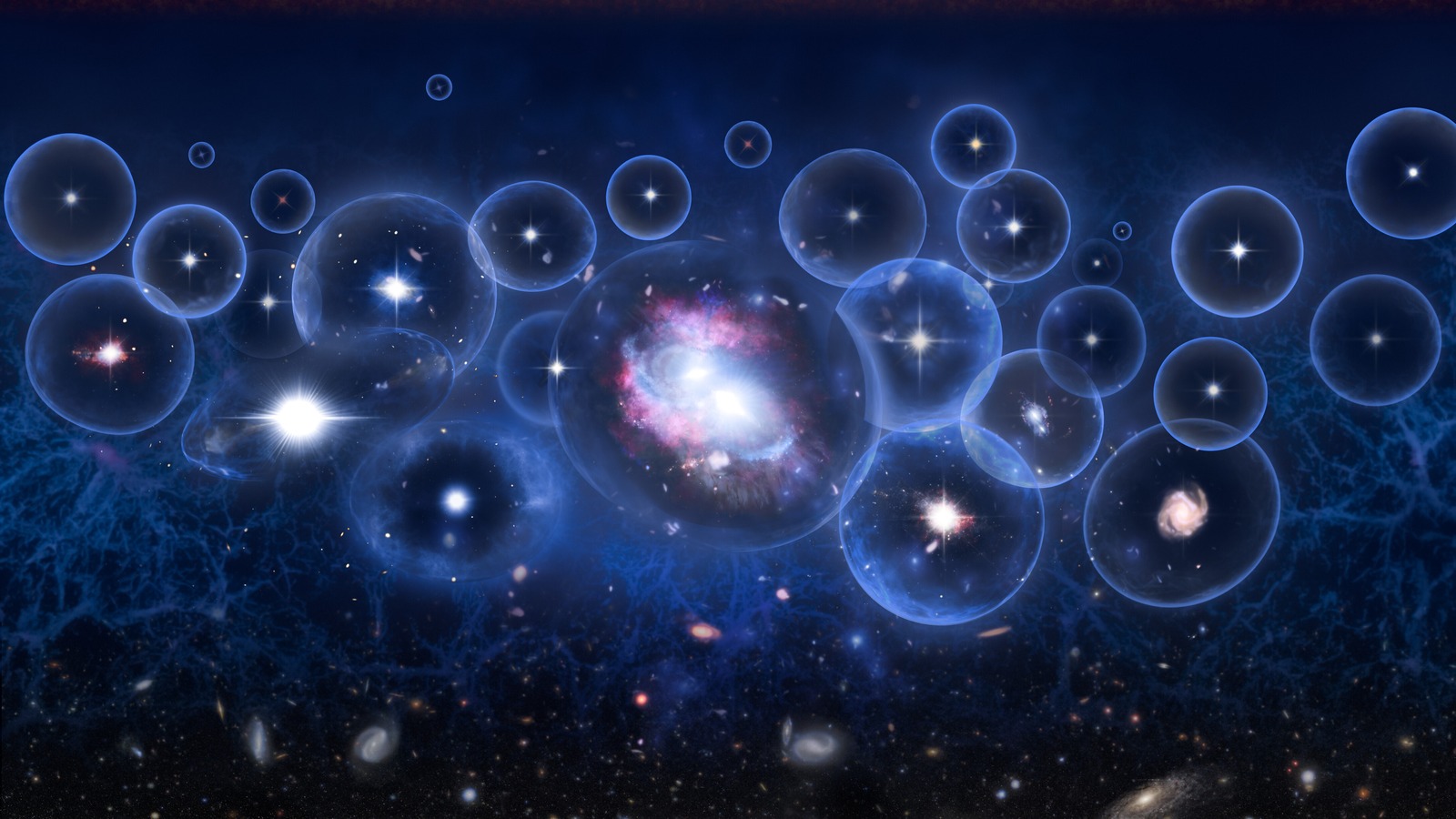
Astronomers have found two giant black holes sitting side by side, both blazing as quasars, in light that left them when the universe was only about 900 million years old. That makes them the oldest close pair of quasars ever found.
The problem is their size. One black hole weighs about 1.5 billion times as much as the Sun, the other about 400 million. That’s as heavy as the giant black holes we see in galaxies today, and nobody can say how they got so big so fast.
“There is no definitive theoretical explanation for how a single one of these giant quasars exists so early in the age of our Universe, much less two,” says Silvia Onorato, a postdoctoral researcher at NSF NOIRLab who led the study. The results were announced Nov. 10, 2026, and are published in The Astrophysical Journal Letters.
What a quasar is
A quasar is a supermassive black hole that is eating fast. Gas and stars swirl toward it, heat up, and shine so brightly that the black hole’s surroundings outshine every star in its own galaxy. That glow is why we can see quasars from so far away.
When galaxies collide and merge, astronomers expect their central black holes to get a big meal at the same time. So close pairs of quasars should be out there. Finding them is the hard part: the bright quasar phase doesn’t last long, quasars this far away are faint, and two of them close together blur into one dot.
Two lights, one dot
The pair is officially called J1602+4228AB. On the sky, the two quasars are just 0.98 arcseconds apart, about the width of a coin seen from more than 3 miles away. In real space, they are roughly 18,100 light-years apart, or about a fifth of the way across our Milky Way. That sounds huge, but for two galaxies it means they’re practically touching.
The second quasar turned up in data from the James Webb Space Telescope. A Webb program called the Aether survey, led by Emanuele Paolo Farina of NSF NOIRLab and the Gemini Observatory, took detailed spectra of 200 early quasars, about 43% of all the known quasars from that era. While the team looked through that data by eye, they spotted that the quasar J1602+4228A had a companion.
A lucky two nights in Hawaiʻi
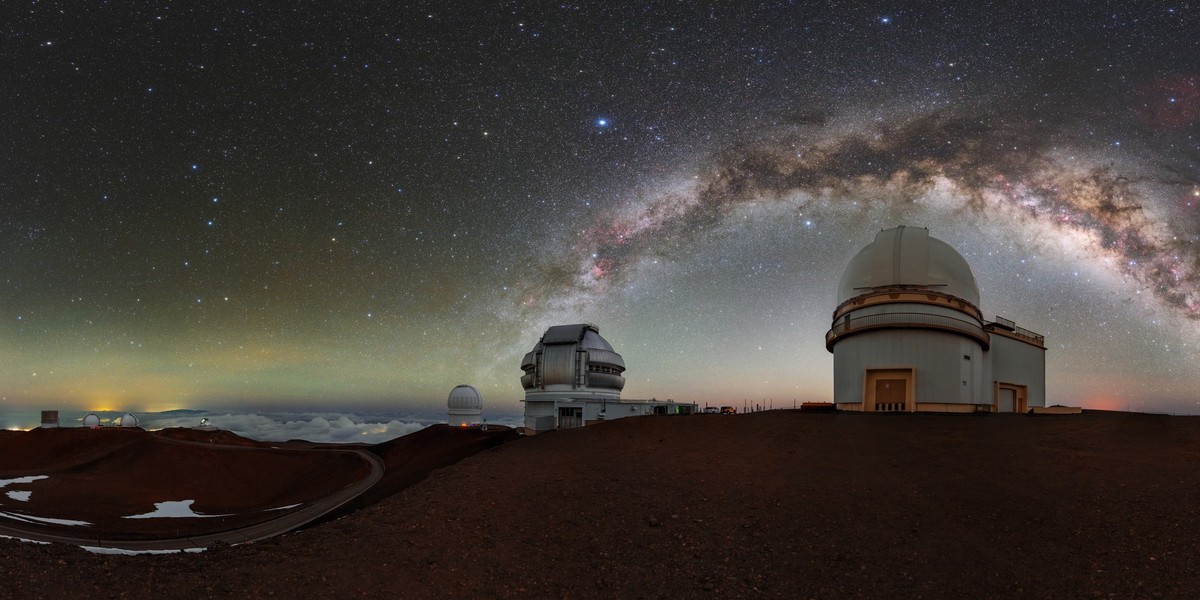
To pull the two apart from the ground, the team used the Gemini North telescope on Maunakea, the dormant volcano on Hawaiʻi Island. The fainter quasar sits so close to the brighter one that this should have been nearly impossible from Earth.
Explore your sky tonightLive sky map for where you are: planets, the ISS and bright stars above your horizon.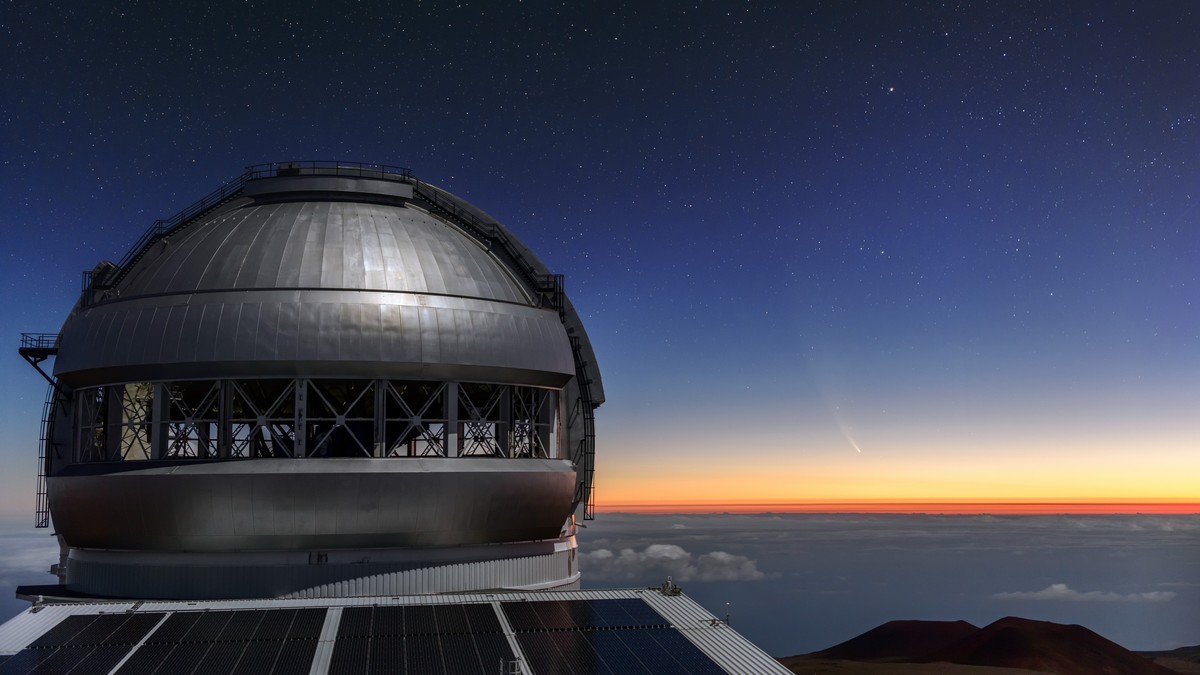
It worked anyway. “The sky over Maunakea was so clean and sharp that we managed to collect the data in only two nights,” Onorato says. Another Gemini instrument tested whether the second quasar could be a mirage: a copy of the first one, bent by the gravity of something in between. The two spectra have different shapes, so the team favors a real pair. They note that a lens model is still needed to rule the mirage out completely.
Too big, too early
Both black holes are feeding at roughly the fastest rate physics normally allows, a limit astronomers call the Eddington limit. According to the paper, the chance of finding a pair this close at this time is about 100 to 1,000 times higher than expected from how quasars cluster on larger scales.
The team’s best guess is that the pair marks an unusually crowded spot in the early universe, where galaxies were running into each other, feeding their black holes and forming stars all at once. It’s only the third quasar pair ever found from this era, which astronomers call cosmic dawn.
“It’s a laboratory for astronomers to study how the very first massive galaxies and their central black holes assembled together through direct galaxy interactions during these early times,” Onorato says.
What the name means
The pair’s Hawaiian name is Nāpōwawāʻenakaulua. It was created by Larry Kimura of Ka Haka ʻUla O Keʻelikōlani, the Hawaiian language college at the University of Hawaiʻi at Hilo, through the A Hua He Inoa naming program at the ʻImiloa Astronomy Center. It translates to “Two celestial bodies of fathomless powerful darkness in the brilliance of heat reincarnating energy into the Universe.”
The name builds on two others from the same program: Pōwehi, the black hole in the first black hole image in 2019, and Pōniuāʻena, a record-breaking distant quasar named in 2020.
Bottom line: Webb and the Gemini North telescope found two feeding giant black holes about 18,100 light-years apart, seen just 900 million years after the Big Bang. They weigh 1.5 billion and 400 million Suns, and no theory yet explains how they grew that big that early.
No Ground. Stay curious.