 No Ground
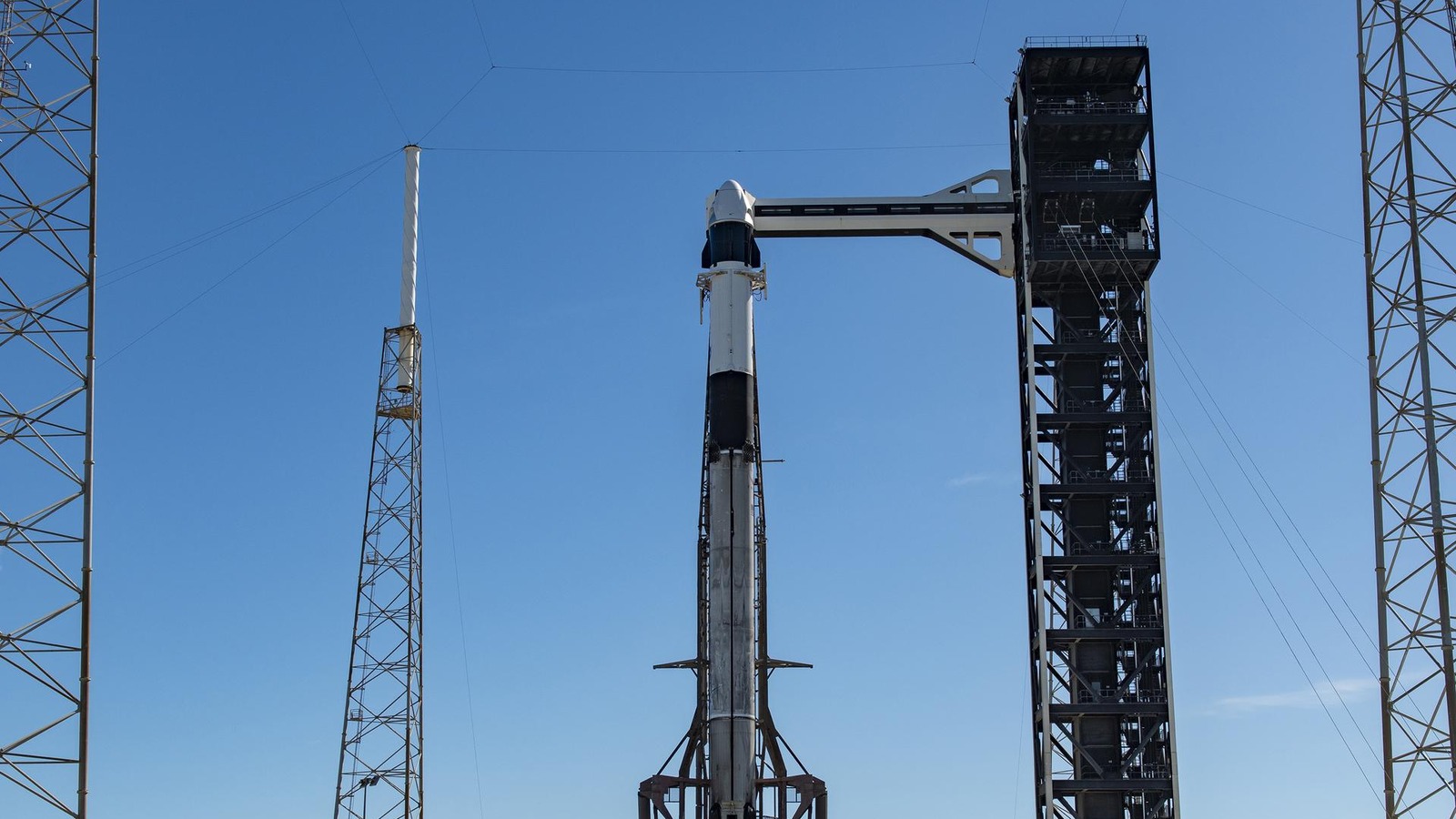
On Oct. 1, 2026, NASA’s SpaceX Crew-13 docked at the International Space Station. Per NASA’s space station blog, NASA astronauts Jessica Watkins and Luke Delaney, CSA (Canadian Space Agency) astronaut Joshua Kutryk, and Roscosmos cosmonaut Sergey Teteryatnikov arrived at 7:05 p.m. EDT, docking to the Harmony module’s forward port. At 7 hours and 55 minutes from liftoff, NASA says this marked the fastest launch-to-docking of a U.S. spacecraft in International Space Station history.
Docked in 7 hours and 55 minutes: the fastest any U.S. spacecraft has reached the station.
Watch the arrival
NASA’s broadcast of the arrival and the welcome remarks is below.
Official NASA video (YouTube).
Hatch opening and handover
After docking, the crew ran standard leak checks and pressurized the tunnel between Dragon and the station. NASA had planned to open the hatch at about 8:45 p.m. EDT; it opened at 9:19 p.m. EDT, and the four floated in to join Expedition 75. Waiting for them were NASA astronauts Jessica Meir, Jack Hathaway and Anil Menon, ESA astronaut Sophie Adenot and Roscosmos cosmonauts Pyotr Dubrov, Anna Kikina and Andrey Fedyaev, which briefly made 11 people aboard.
The overlap gave the departing Crew-12 about a week to show the newcomers around. Crew-12’s Dragon undocked on Oct. 7 and splashed down off Los Angeles on Oct. 8, after 237 days in orbit. We covered that landing in Crew-12 comes home.
How they got here
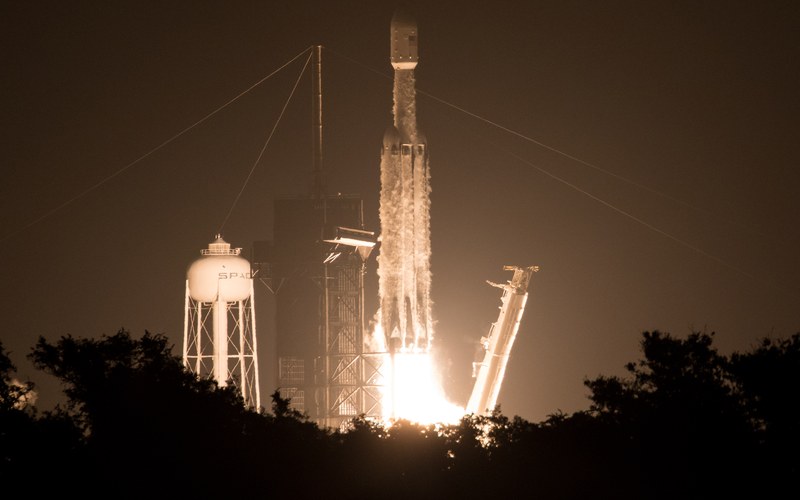
Liftoff was on time at 11:10 a.m. EDT from Space Launch Complex 40 at Cape Canaveral Space Force Station, aboard Falcon 9 with Dragon spacecraft Grace. NASA confirmed Dragon reached orbit, separated from the second stage, and opened its nosecone; Falcon 9’s first stage landed at Landing Zone 40.
How Dragon catches the station
A spacecraft cannot simply aim at the station and fly straight there. Both are moving at about 28,000 km/h, and Dragon reaches orbit lower and behind. SpaceX describes the chase in steps. After separating from the rocket, Dragon checks out its engines, life support and thermal systems. It then fires its thrusters in a series of “phasing” burns that raise its orbit a little at a time, so it catches up from below. Once it is close, it sets up a communication link with the station, makes a final orbit-raising burn and moves onto the docking axis. The last approach and docking are automatic; the crew watches and can take over if needed.
How long that takes depends on where the station is when the rocket launches. Crew flights have often needed a day or more. On Oct. 1, the geometry was close to ideal. “We got lucky this time,” SpaceX’s Julianna Scheiman said after launch, according to Space.com. “The space station was in an opportune spot in space, and the orbital mechanics, the physics of it all, worked out.”
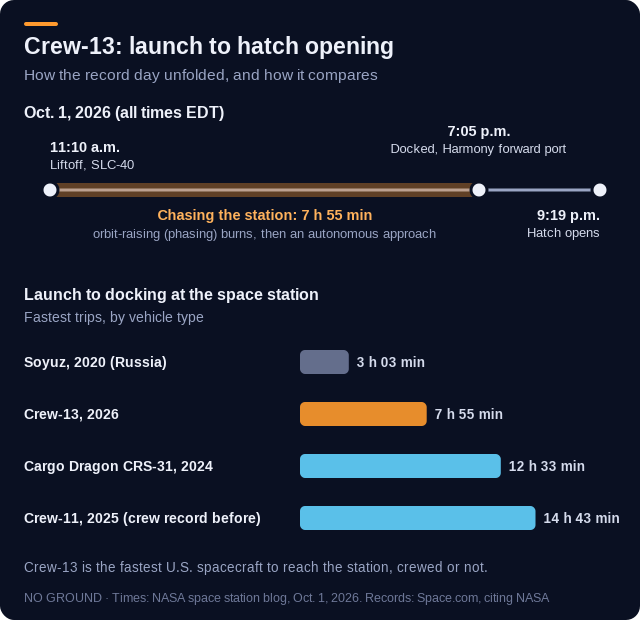
The comparison helps. Before Crew-13, the fastest U.S. trip to the station was 12 hours and 33 minutes, by the robotic CRS-31 cargo Dragon in November 2024. The fastest U.S. crew trip was Crew-11’s 14 hours and 43 minutes in August 2025. Russia still holds the overall record: a Soyuz reached the station in about 3 hours in 2020, after just two laps of Earth.
Who is flying
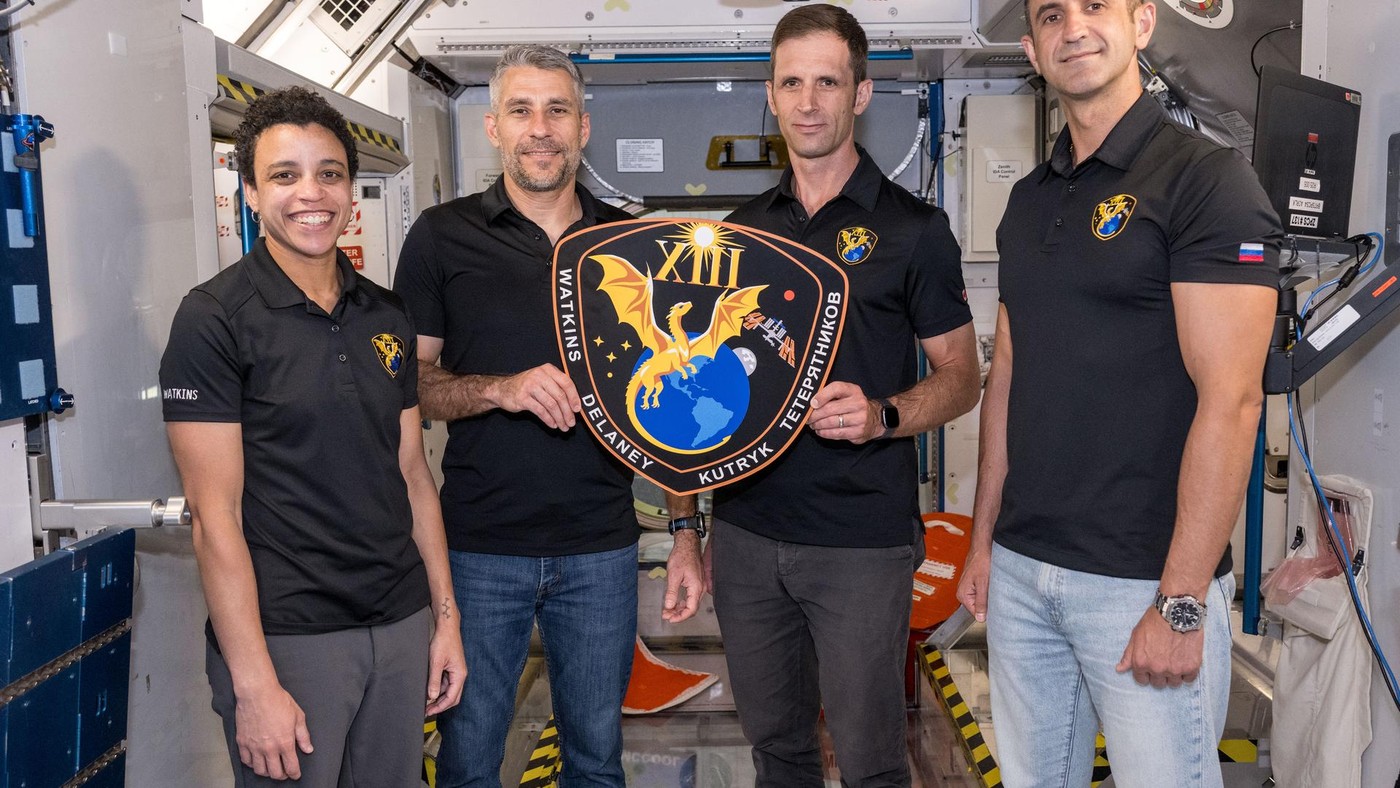
NASA astronaut Jessica Watkins commands the flight. NASA astronaut Luke Delaney is the pilot. Mission specialists are CSA (Canadian Space Agency) astronaut Joshua Kutryk and Roscosmos cosmonaut Sergey Teteryatnikov.
Explore your sky tonightLive sky map for where you are: planets, the ISS and bright stars above your horizon.Watkins previously spent 170 days on the station on Crew-4 in 2022. NASA says she is the first agency astronaut to launch twice aboard a SpaceX Dragon. For Delaney, Kutryk, and Teteryatnikov, this is a first trip to orbit.
Rocket, spacecraft, station stay
Grace previously flew the private Axiom Mission 4 flight in summer 2025, per NASA’s mission overview. After arrival, Crew-13 joined Expedition 75 for a stay of about six months.
Why this flight matters
Crew-13 is the 13th operational NASA Commercial Crew rotation to the station with SpaceX. Once on board for a long-duration stay, the crew is expected to support research NASA highlights for future Moon and Mars missions and for life on Earth — including stem-cell–derived tissue work relevant to heart disease and Parkinson’s disease, crop production studies, blood-flow research, and tests of diagnostic medical equipment.
The path to today’s launch was not straight. In late August, NASA and SpaceX slipped the schedule after an oxidizer leak was found in Dragon’s propulsion system during prelaunch processing. Teams completed repairs and a Launch Readiness Review; on Sept. 30, mission leaders polled “go” to proceed into the count.
The first weeks aboard
The crew got busy fast. Kutryk made the first spacewalk of his career on Oct. 29, with NASA’s Anil Menon, to install the station’s seventh roll-out solar array, and went out again with Menon on Nov. 5 to install the eighth and last one. That walk completed a power upgrade that began in 2021. We explained what the arrays do in the station’s last new solar array. The arrays themselves arrived on the CRS-35 cargo Dragon, which launched on Oct. 13.
Kutryk’s first spacewalk made him the fifth Canadian to walk in space, and the first since 2019. More cargo ships are due over the winter, and the crew’s research list is long: tissue chips, plant growth and medical devices that could one day fly to the Moon.
Four people arrived at the station on Oct. 1 in record time. As of mid-November, they are about seven weeks into a stay of roughly six months.
No Ground. Stay curious.