 No Ground
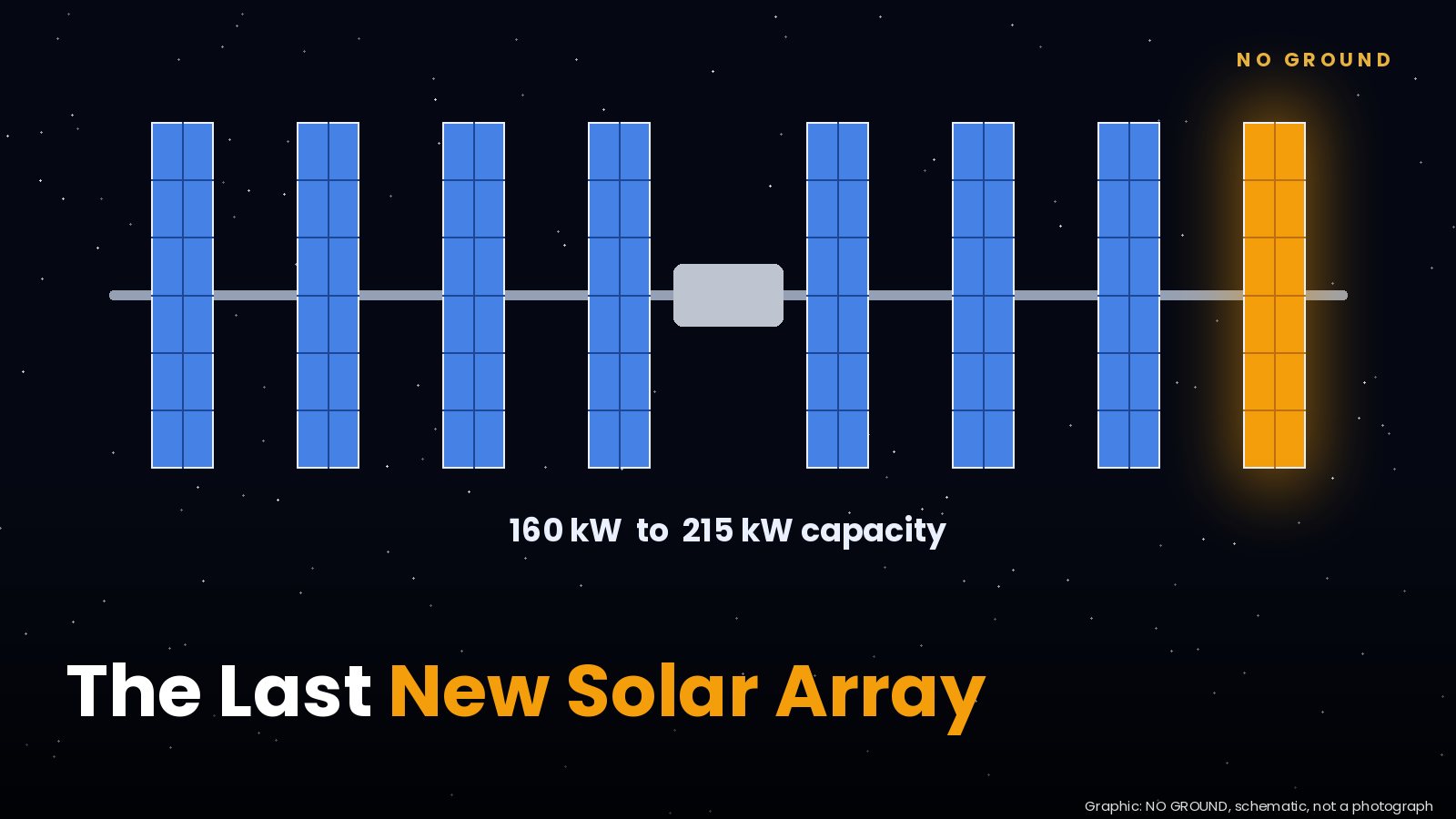
On Thursday, Nov. 5, two astronauts floated out of the International Space Station and finished a job that has taken more than five years: they installed the eighth and final roll-out solar array.
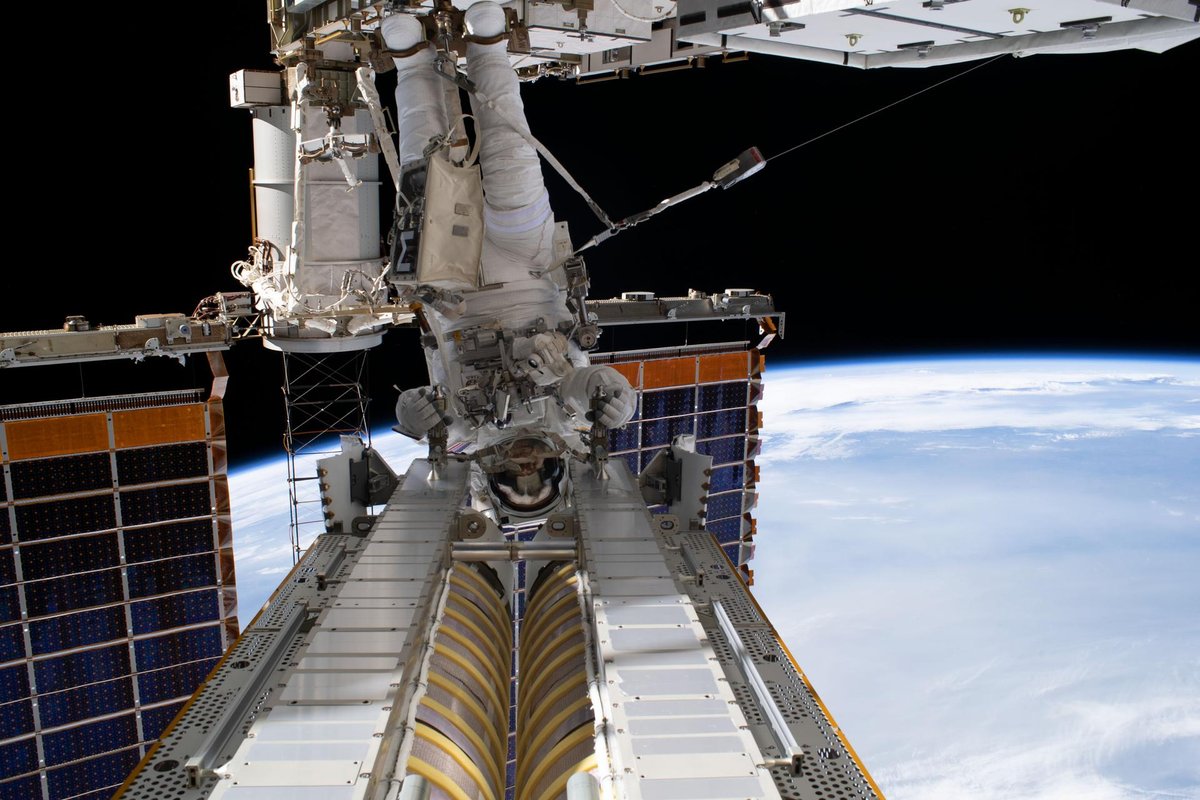
NASA astronaut Anil Menon and Canadian Space Agency astronaut Joshua Kutryk went outside at 8:36 a.m. EST. They finished at 3:35 p.m. EST, a spacewalk of 6 hours and 59 minutes. The new array was installed on power channel 3B, on the station’s starboard truss, and then unfurled.
What the upgrade adds
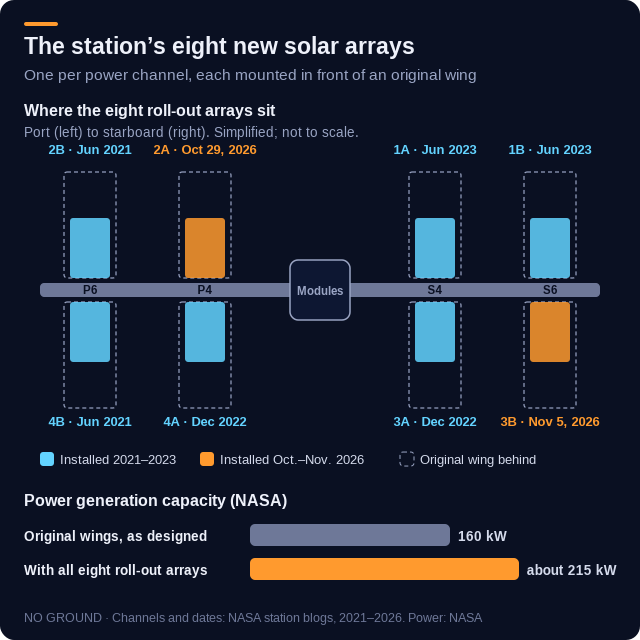
With all eight arrays in place, the station’s power generation capacity rises from 160 kilowatts to about 215 kilowatts, according to NASA. NASA says this completes the station’s power augmentation upgrades.
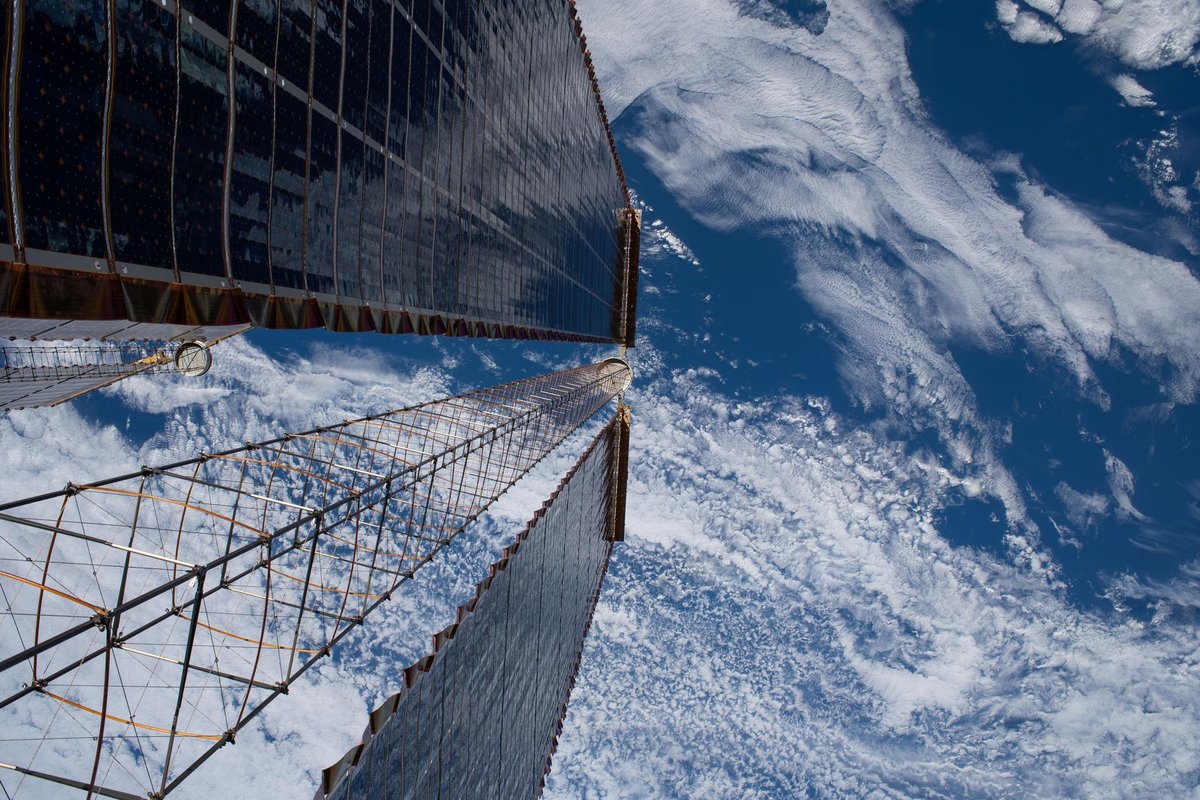
Each array is called an ISS Roll-Out Solar Array, or IROSA. It arrives rolled up, then unrolls in orbit using energy stored in its own carbon-fiber booms. Each one produces more than 20 kilowatts, according to NASA. They are mounted in front of the station’s original solar wings, so the unshaded parts of the old panels keep producing power too.
How a roll-out array works
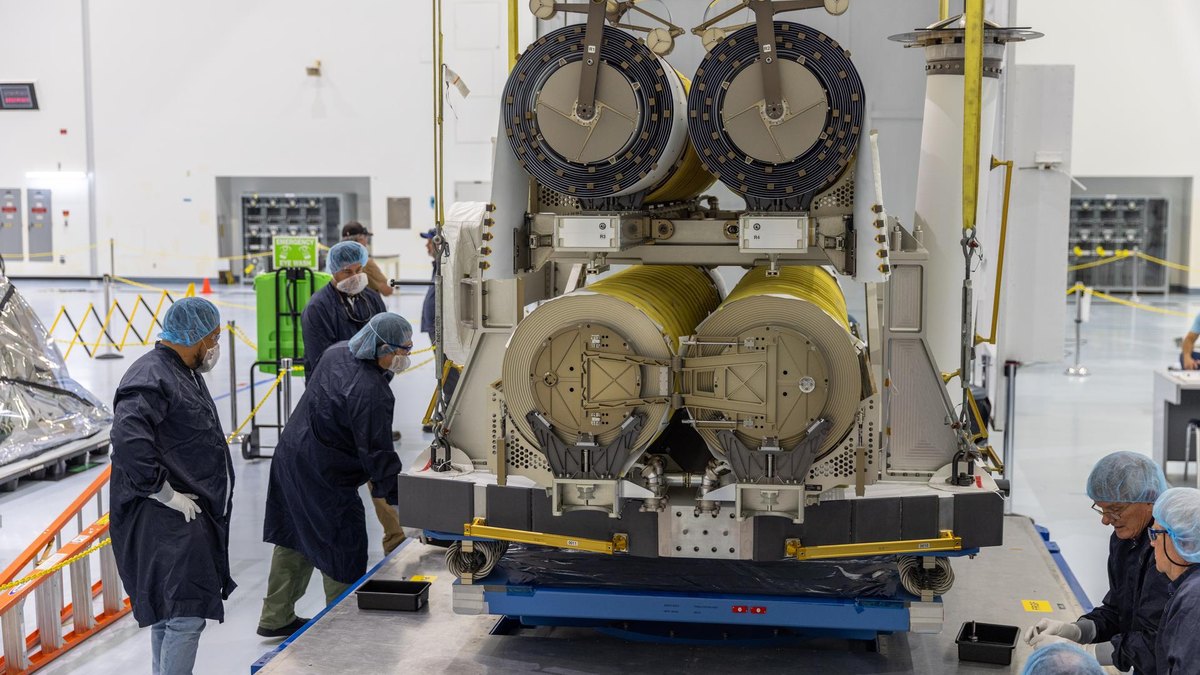
The old wings were folded up like a giant accordion for launch and opened by a mast. The new arrays work more like a tape measure. Each one flies rolled up into a compact cylinder. Once it is bolted on, the astronauts release it, and two carbon-fibre booms, which store energy when they are rolled flat, spring back into tubes and pull the blanket of solar cells out behind them, without heavy motors to drive it.
NASA tested the idea first with a small Roll-Out Solar Array that flew on the station in June 2017. The full-size versions were designed, built and tested by Redwire under a contract with Boeing, NASA’s station prime contractor. Each is about 18 metres long and 6 metres wide (60 by 20 feet), roughly half the size of the original wings it sits in front of, but with more efficient cells.
Why it was needed
The station’s original solar wings were delivered by space shuttles between 2000 and 2009 and were designed to last about 15 years. They have been working far longer, and their output has slowly declined with age.
The new arrays give the station more power for its remaining years. NASA plans to retire the station and bring it down in 2030.
What “final” means
The upgrade was planned in stages. NASA first announced six arrays, mounted in front of six of the station’s eight original wings, and astronauts installed them in pairs in June 2021, December 2022 and June 2023. In 2023, NASA’s power projections led it to order two more, so that every one of the eight power channels would get one. Those last two flew up in the trunk of the CRS-35 Dragon in October, which we covered in the CRS-35 launch.
“Final” therefore means two things. It is the last of the eight arrays, and it is the last major addition to the station’s power system before the end of the station’s life. NASA said after the Oct. 29 spacewalk that the extra power will support “critical operations, including a safe and controlled deorbit.” In NASA’s plan, a SpaceX-built deorbit vehicle will push the station down over a remote part of the ocean once it is retired. The two astronauts who finished the job arrived very differently: Kutryk came up on the record-fast Crew-13 flight on Oct. 1, and Menon was already aboard.
The two spacewalks
This was the second and final spacewalk in a pair. On Oct. 29, Menon and Kutryk installed the seventh array on power channel 2A, on the port-side truss. That walk began at 7:57 a.m. EDT and ended at 3:08 p.m. EDT, about 7 hours and 11 minutes.
See when the Space Station passes over youThe ISS is bright enough to spot with your eyes. The live map shows where it is right now and where to look.The final array went on the far end of the truss, beyond the reach of the station’s robotic arm, so the astronauts had to move it along the truss themselves. NASA had planned a technique nicknamed the “leapfrog,” in which the array is passed between foot restraints along the truss.
The last two arrays arrived on a SpaceX cargo Dragon that launched on Oct. 13. Each assembly weighs about 750 pounds (340 kilograms).
By the numbers
Menon, a U.S. Air Force lieutenant colonel and emergency physician, made his fifth spacewalk. Kutryk, a Royal Canadian Air Force colonel and test pilot, made his second. Kutryk’s first spacewalk, on Oct. 29, made him the fifth Canadian to walk in space and the first since 2019.
NASA counts this as U.S. spacewalk 101 and the 286th spacewalk in support of station assembly, maintenance and upgrades. Altogether, astronauts have made 18 spacewalks since February 2021 to prepare power channels and install the eight arrays.
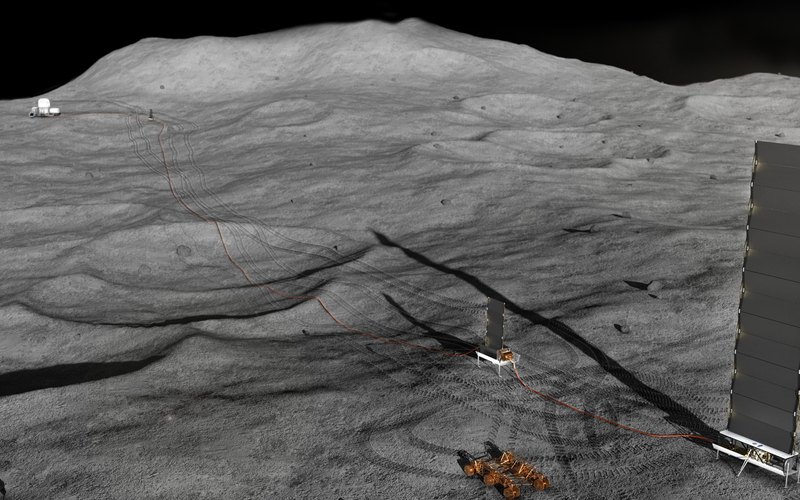
The station is not the only place NASA is thinking hard about power. On the Moon’s south pole, where nights can last two weeks, solar panels are not enough, which is why NASA is working on a nuclear power plant for the Moon.
Bottom line: The space station now has all eight new roll-out solar arrays, each producing more than 20 kilowatts, raising its power capacity from 160 to about 215 kilowatts for its final years.
No Ground. Stay curious.