 No Ground
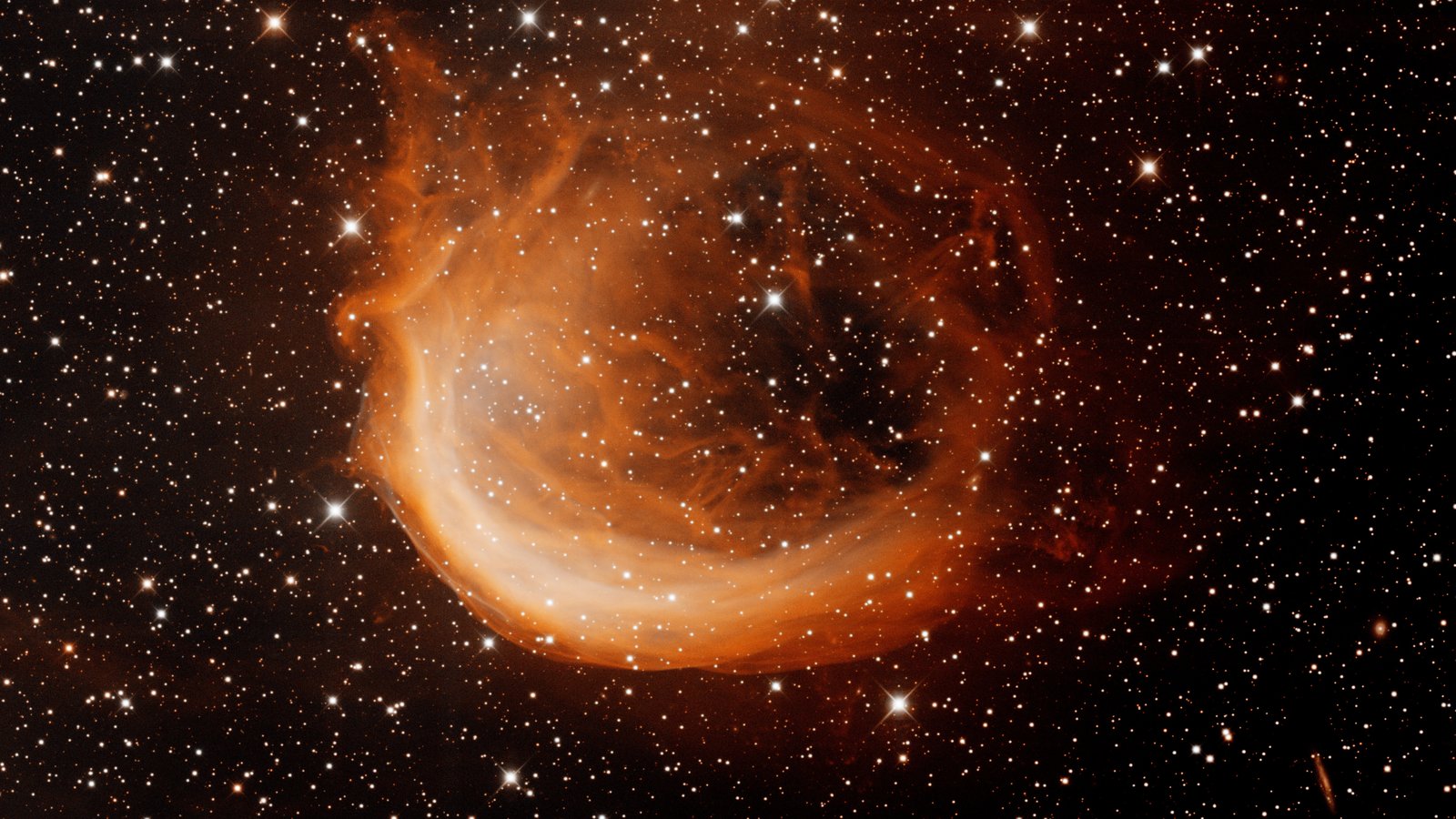
Look long enough at Cassiopeia’s W and you will find a faint crescent that does not belong to any cartoon. Catalogued as Sh2-188 — and nicknamed the Shrimp Nebula — it is a planetary nebula: the outer layers of a Sun-like star, shed late in life and lit by the hot core left behind.
That core is now a white dwarf, racing through the thin gas between the stars. The shrimp shape is not a joke of the imagination. It is a bow shock — the glow of gas piled up where the nebula plows forward, like the wave ahead of a boat.
Not a bubble. A wake.
Most planetary nebulae look roughly round because their shells expand into relatively calm surroundings. Sh2-188 does not get that luxury. Models that match its bright southeastern arc and faint trailing filaments need the central star moving at about 125 kilometers per second relative to the interstellar medium — about 450,000 kilometres an hour, roughly 500 times faster than a cruising jet airliner, for a stellar remnant thousands of light-years away.
Ahead of the motion, the shell compresses and brightens into a sharp, filamentary limb. Behind it, faint material stretches downstream. Deep hydrogen-alpha imaging has even shown a thin opposite arc and a long tail — evidence that most of the mass lost earlier may already have been swept that way.
How a bow shock forms
Space between the stars is not empty. It holds a very thin mix of gas and dust, often just a few atoms in each cubic centimetre. That is far emptier than any vacuum made on Earth, but when something crosses it fast enough, it still pushes back.
A bow shock forms when an object moves through a gas faster than pressure waves can travel through that gas. The gas cannot get out of the way smoothly, so it piles up in a curved front, the same shape a boat makes on a lake or a fast jet makes in air. Earth has one too: the solar wind slams into our magnetic field and forms a bow shock on the side facing the Sun. ESA’s Smile mission was launched to take X-ray pictures of that boundary.
In Sh2-188, the trouble started before the nebula even lit up. Late in its life the star puffed off its outer layers in a slow wind, and that material ran into the oncoming interstellar gas. On the leading side the gas was squeezed and piled up; on the trailing side it was pulled into a long tail. Wareing and colleagues reproduced the shape in 2006 with a computer model of three winds, the slow wind, a later fast wind from the exposed hot core and the star’s motion, and found it only works at about 125 km/s. In their model, the bright front and the tail had already formed before the nebula began to glow, and most of the mass the star shed has been swept downstream. Their deep images show the whole thing spans about 15 arcminutes, half the width of the full Moon.
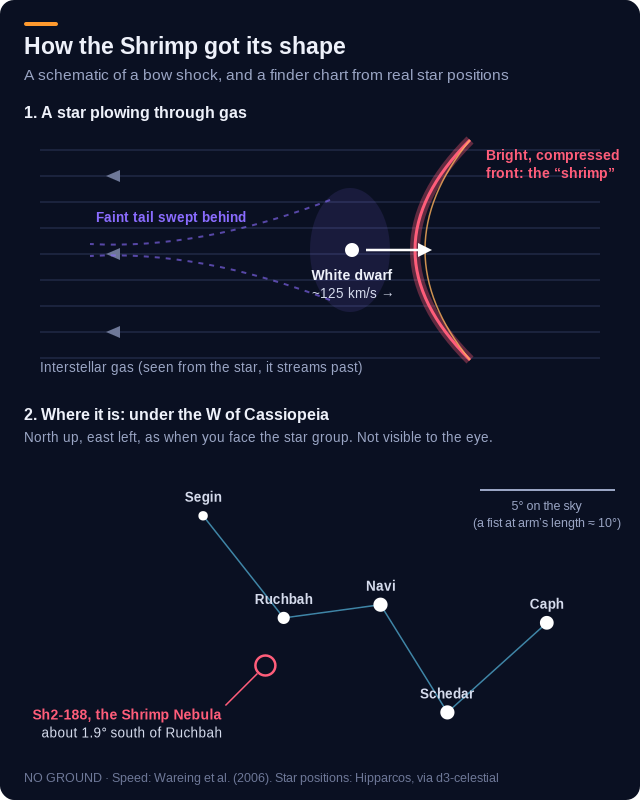
The shrimp is not decoration. It is motion made visible.
What “planetary” actually means
The word is historical, not literal. Through small telescopes, some of these shells looked disk-like, so astronomers borrowed the language of planets. Physically, a planetary nebula is a late chapter for stars with roughly the Sun’s mass: the envelope drifts outward while the exposed core floods it with ultraviolet light until the gas fluoresces.
See where the Shrimp Nebula is in your skyToo faint for the eye, but the live map shows where to point and when it is up.In Sh2-188’s case, that fluorescence is strongest where the remnant rams into ambient gas. Compress the leading edge and it brightens — which is why the “body” of the shrimp reads so clearly in long exposures, even though the nebula is faint to the naked eye. On the sky it spans roughly half the Moon’s angular diameter, yet you will not stumble on it without a dark sky, filters, or a photograph.
Distance estimates still carry wide uncertainty — often cited near 850 parsecs, on the order of 2,800 light-years — but the geometry of the shock does not wait for a perfect yardstick. Proper motion of the central star points toward the bright limb. Speed and shape tell the same story.
Standing under Cassiopeia
Cassiopeia is one of the easiest star patterns to find in the northern sky. Its five brightest stars form a W, or an M, depending on the time of night. From mid-northern latitudes, such as New York or Rome, it never sets: it circles the North Star, low in the north on spring evenings and high overhead on autumn and early-winter evenings. If you can find the North Star, Cassiopeia is on the opposite side of it from the Big Dipper.
Sh2-188 lies about 1.9 degrees south of Ruchbah, the second star from the eastern (left-hand) end of the W, by our calculation from catalogue positions. That is less than four Moon-widths. But the nebula is far too faint for your eyes, even in binoculars. It shows up in long-exposure photographs, usually taken through filters that pass the red light of hydrogen and the blue-green light of oxygen.
You do not need to see the shrimp with your own eyes for the idea to land. Somewhere under that familiar W, a dying star’s leftover core is still moving — still pushing a glowing front through the thin weather of the galaxy. The light that reaches you tonight left years ago. The motion is still happening.
Tonight the sky holds a shrimp-shaped wake of hydrogen and oxygen. You are under it. The white dwarf is still racing. The bow shock is still bright.
If you like nebulae with a story, two other No Ground pieces fit here: the Cat’s Paw Nebula, where new stars are forming, and Webb’s view of NGC 7129, a young cluster still wrapped in its birth cloud. Sh2-188 is the opposite end of the story: a star that is almost finished, still leaving a mark as it goes.
No Ground. Stay curious.