 No Ground
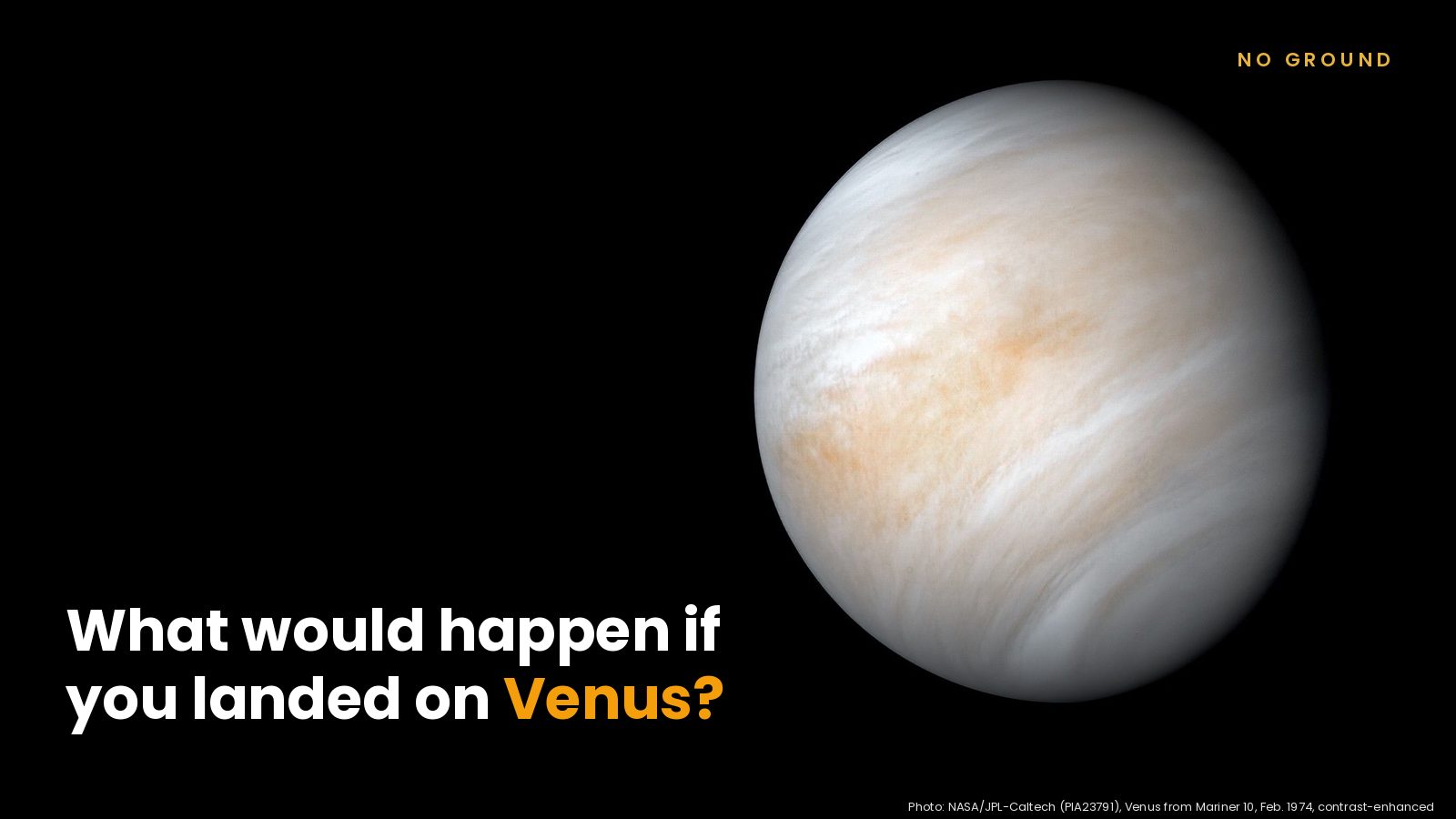
If Earth has a twin, it is Venus. It is about the same size and sits right next door. But step onto its surface and you would not last long.
The heat
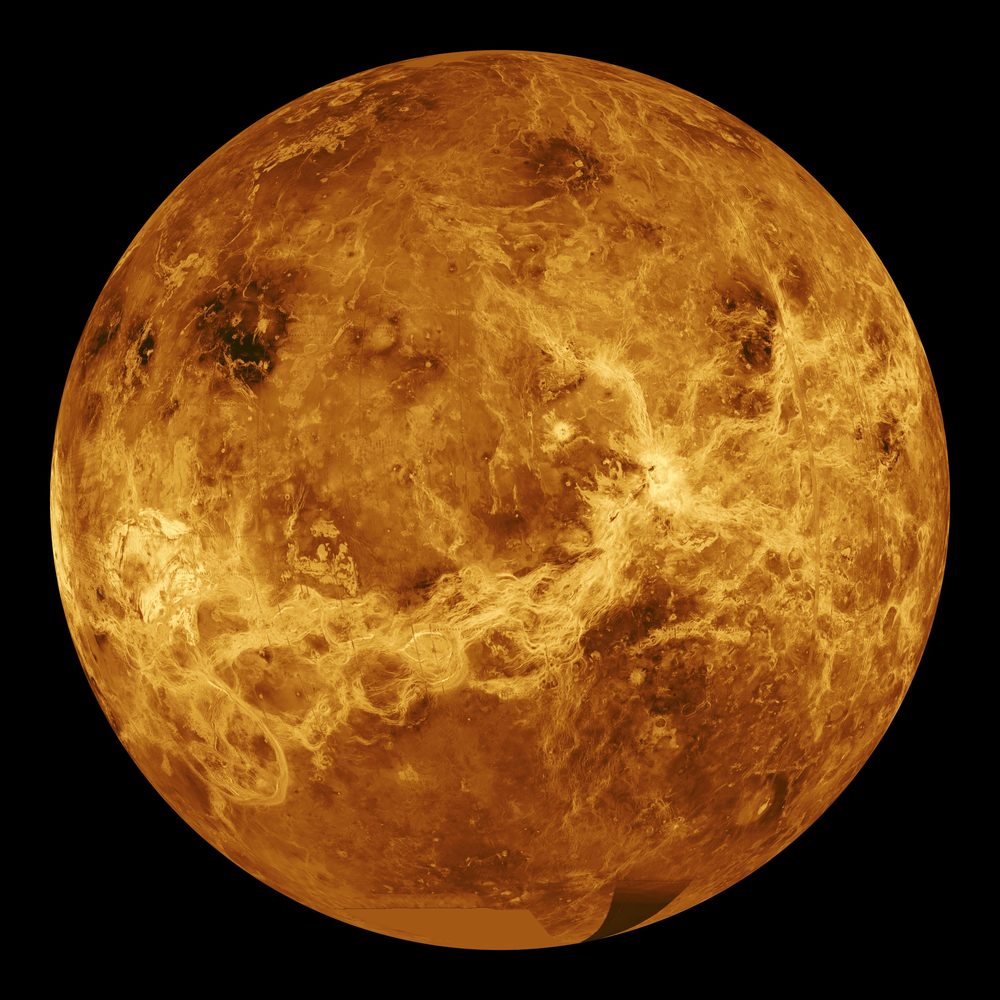
The surface of Venus is about 465 °C (around 870 °F). That is hot enough to melt lead, and hotter than Mercury, even though Mercury is closer to the Sun. The reason is Venus’s thick carbon dioxide atmosphere, which traps heat in a runaway greenhouse effect.
It probably did not start this way. When NASA’s Pioneer Venus probes sampled the atmosphere in 1978, they found heavy hydrogen (deuterium) about 100 times more common, relative to ordinary hydrogen, than it is in Earth’s water. The simplest explanation is that Venus once had much more water and lost most of it to space. Ordinary hydrogen escapes more easily than the heavier kind, so what is left behind is enriched.
The usual story goes like this. Venus gets almost twice as much sunlight as Earth. As the young Sun slowly brightened, more water evaporated, and water vapour is itself a greenhouse gas, so the warming fed on itself. High in the atmosphere, sunlight split the water molecules and the hydrogen leaked away. Without liquid water, Venus also lost the process that, on Earth, slowly locks carbon dioxide into rocks. The carbon dioxide stayed in the air. Scientists still do not know exactly when this happened, or what tipped it.
The pressure
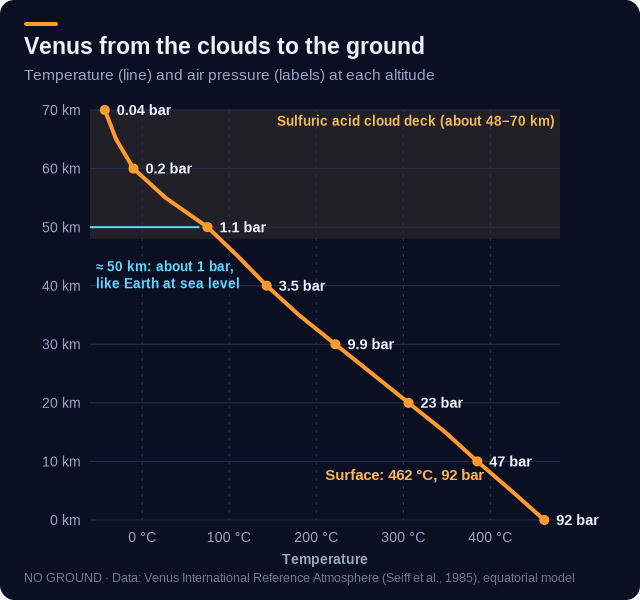
The air at the surface presses down more than 90 times harder than on Earth. That is like being nearly a kilometre (about 900 metres, or 3,000 feet) under the ocean, except the “water” is a hot gas.
Here is how the two “twins” compare, using NASA’s planetary fact sheets:
- Size: Venus is 12,104 km across; Earth is 12,756 km. Venus’s gravity is about 90 percent of ours.
- Average surface temperature: about 464 °C on Venus; about 15 °C on Earth.
- Surface pressure: about 92 bar on Venus; 1 bar on Earth.
- Air: 96.5 percent carbon dioxide and 3.5 percent nitrogen on Venus; mostly nitrogen and oxygen on Earth.
- Length of a day (sunrise to sunrise): about 117 Earth days on Venus; 24 hours on Earth.
- Year: 224.7 Earth days on Venus; 365.25 on Earth.
The sky
High above, the clouds are made largely of sulfuric acid. Very little sunlight reaches the ground, so the surface is dim, and the light that gets through gives it an orange tint.
Find Venus in your skyLive sky map for where you are: when it rises and where to look.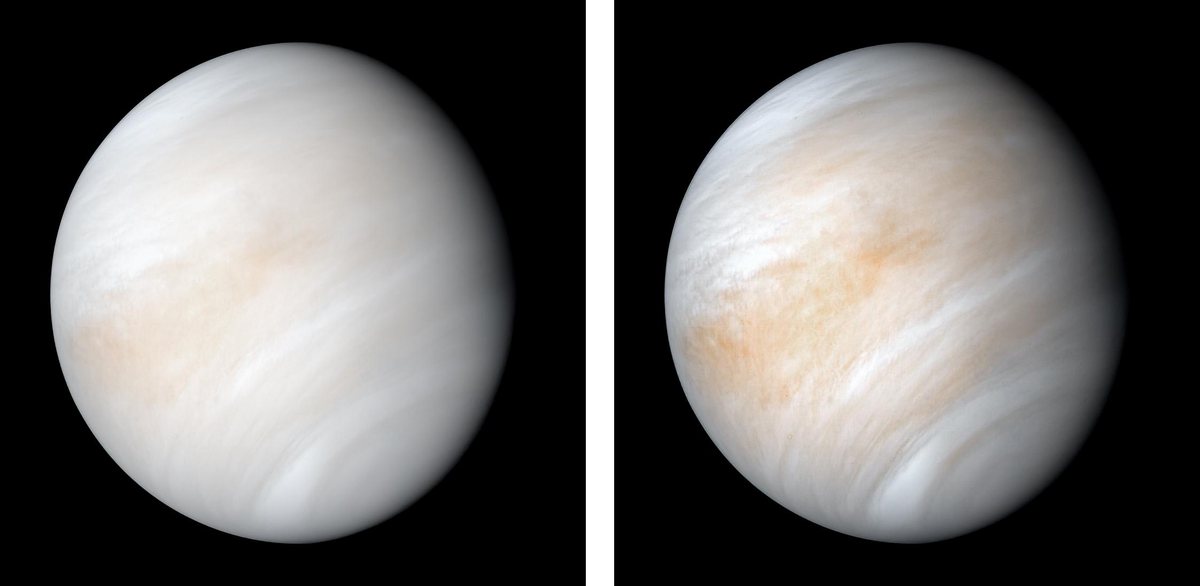
A strange day
Venus spins backwards compared with most planets, and very slowly. One spin takes about 243 Earth days, which is longer than its 225-day year.
Because it spins backwards while it orbits, the time from one sunrise to the next works out to about 117 Earth days. If you could see through the clouds, the Sun would rise in the west and set in the east, and an afternoon would last for weeks. The thick air spreads the heat so well that night is about as hot as day, and the poles are about as hot as the equator.
Has anything survived?
Only briefly. Soviet Venera probes landed in the 1970s and 80s. The best of them, Venera 13, touched down on 1 March 1982 and transmitted for about two hours (127 minutes, against a planned 32) before the heat and pressure ended it.
Those two hours were a scene no one had seen before. Venera 13 landed just east of a highland region called Phoebe Regio and sent back the first colour pictures from the surface of Venus: flat, layered slabs of rock and dark soil under orange-tinted light. A small drill took a sample of the ground, which was pulled inside and analysed by X-ray fluorescence. Soviet scientists reported a rock similar in chemistry to some volcanic rocks on Earth.
NASA’s archive puts the conditions at the landing site at about 457 °C and 89 times Earth’s air pressure. The lander was designed to last 32 minutes. It kept working for 127, and then it went silent. Its twin, Venera 14, landed a few days later and lasted 57 minutes.
No spacecraft has touched the surface since the Soviet Vega landers in 1985. Electronics, batteries and seals all fail at these temperatures, and a lander cannot carry enough insulation to stay cool for long. Every visit so far has been a race against the clock, and the clock has always won.
Who is going back
After decades of quiet, three new missions are on the books, all for the early 2030s. Their dates have moved before, so treat them as targets, not promises.
- DAVINCI (NASA): a probe that will fall through the atmosphere under a parachute, tasting the gases and taking the first pictures of the surface since 1982. In October 2026 the team said launch is now planned for December 2030, with the probe’s descent set for Oct. 3, 2032. The fall to the ground takes about an hour.
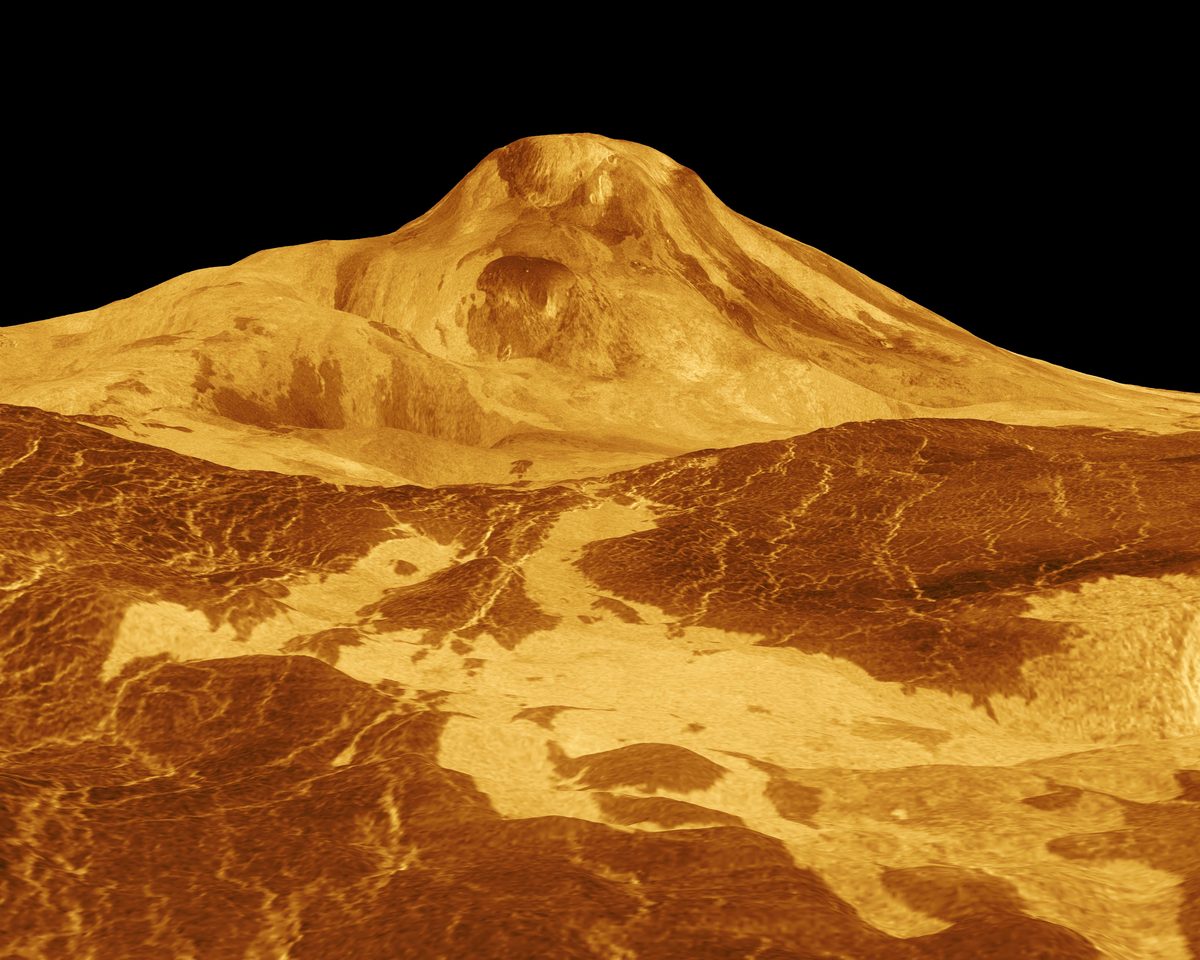
- VERITAS (NASA): an orbiter with a radar far sharper than Magellan’s, to map the surface and look for active volcanoes. It is now funded for launch in November 2032.
- EnVision (ESA): a European orbiter, also aimed at 2032, to study the surface and what lies beneath it. After NASA pulled out of supplying its radar, ESA said it will build its own.
None of them will land and stay. DAVINCI’s probe only has to survive the descent and a few minutes after; in a 2026 furnace test, the team said its insulated sphere kept the inside below 30 °C. If you want a sense of how extreme Venus is, compare it with how cold space itself can get, or with how thin Earth’s own air is. The only other world with a thick atmosphere and a landing on the calendar is Saturn’s moon Titan, where NASA’s Dragonfly rotorcraft is due in 2034.
Bottom line: Venus is Earth’s size but has 92 times the air pressure and is hot enough to melt lead. The best lander lasted 127 minutes. It is the closest thing we have to a warning about what a planet can become.