 No Ground
The short answer: it doesn’t. A full Moon rising over the rooftops can look enormous, but if you measure it, it is the same width as the Moon high overhead later that night. In fact, the rising Moon is very slightly farther away from you. The giant Moon is an illusion made by your brain, and it is so strong that scientists have argued about it for more than 2,000 years.
Here is what is really going on, how to prove it to yourself with nothing but your hand, and why the explanation is still not completely settled.
The Moon is not bigger, and not closer, on the horizon
The first thing many people guess is that our air works like a magnifying glass when the Moon is low. It doesn’t. NASA is clear on this: the atmosphere is not magnifying the Moon. Photos taken with the same camera and zoom show the rising Moon and the high Moon are the same width, side to side.
If anything, the air does the opposite. Light from the low Moon skims through a thick slice of atmosphere, and the air bends light from the Moon’s bottom edge a little more than light from its top edge. That squashes the Moon into a slightly flattened oval. It is the same bending of light that makes stars twinkle and makes the setting Sun look squished.
The second guess is that the Moon is closer when it rises. The geometry says no. When the Moon is straight overhead, you are standing on the side of Earth facing it, so you are about one Earth radius, roughly 3,960 miles, closer to it than when it sits on the horizon. NASA puts the difference at about 1.5 percent. So the rising Moon is a hair smaller in the sky, not bigger.
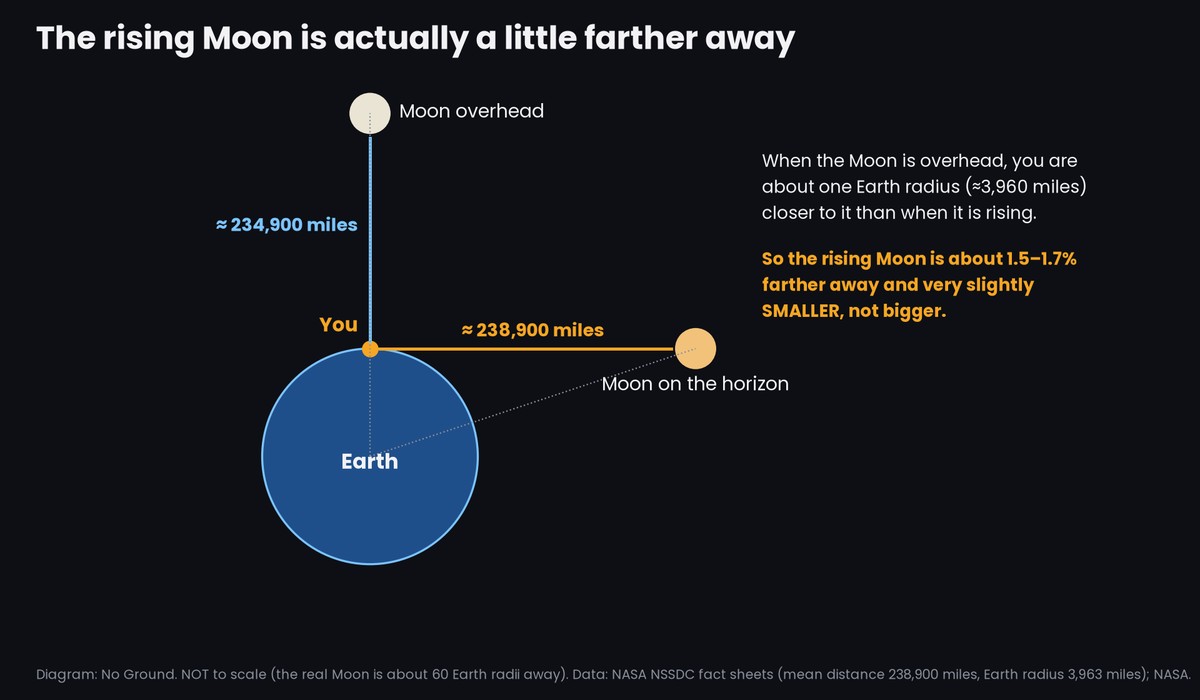
There is one real change you can see: color. A low Moon often looks yellow, orange or even reddish. Its light crosses much more air on the way to you, and the air scatters away more of the blue, leaving warmer colors behind. It is the same reason sunsets turn orange. Color changes, but size does not.
Prove it to yourself in 30 seconds
You don’t have to take anyone’s word for this. Next time the Moon is rising and looks huge, try one of these tests suggested by NASA:
- The finger test. Hold your arm straight out and put your index finger next to the Moon. Your fingernail and the Moon are about the same size. Do it again a few hours later when the Moon is high. It will match your nail just the same. By our math, the Moon’s half-degree width works out to less than a quarter of an inch at arm’s length.
- The tube test. Look at the rising Moon through a paper towel tube or a rolled-up sheet of paper. Once the trees and rooftops disappear from view, the Moon suddenly looks ordinary.
- The upside-down test. Bend over and look at the Moon backward between your legs. For many people the giant Moon shrinks right away.
- The camera test. Take a photo of the rising Moon, then another of the high Moon later that night with exactly the same zoom setting. Measure the width in both. They match.
If the Moon itself isn’t changing, then the change must be happening in us.
So what is your brain doing?
Your brain is constantly guessing how big things are by combining two clues: how big they look and how far away they seem. A car on the far end of a parking lot looks tiny to your eye, but you don’t think it is a toy, because your brain knows it is far away. That automatic correction is usually very useful. With the Moon, it backfires.
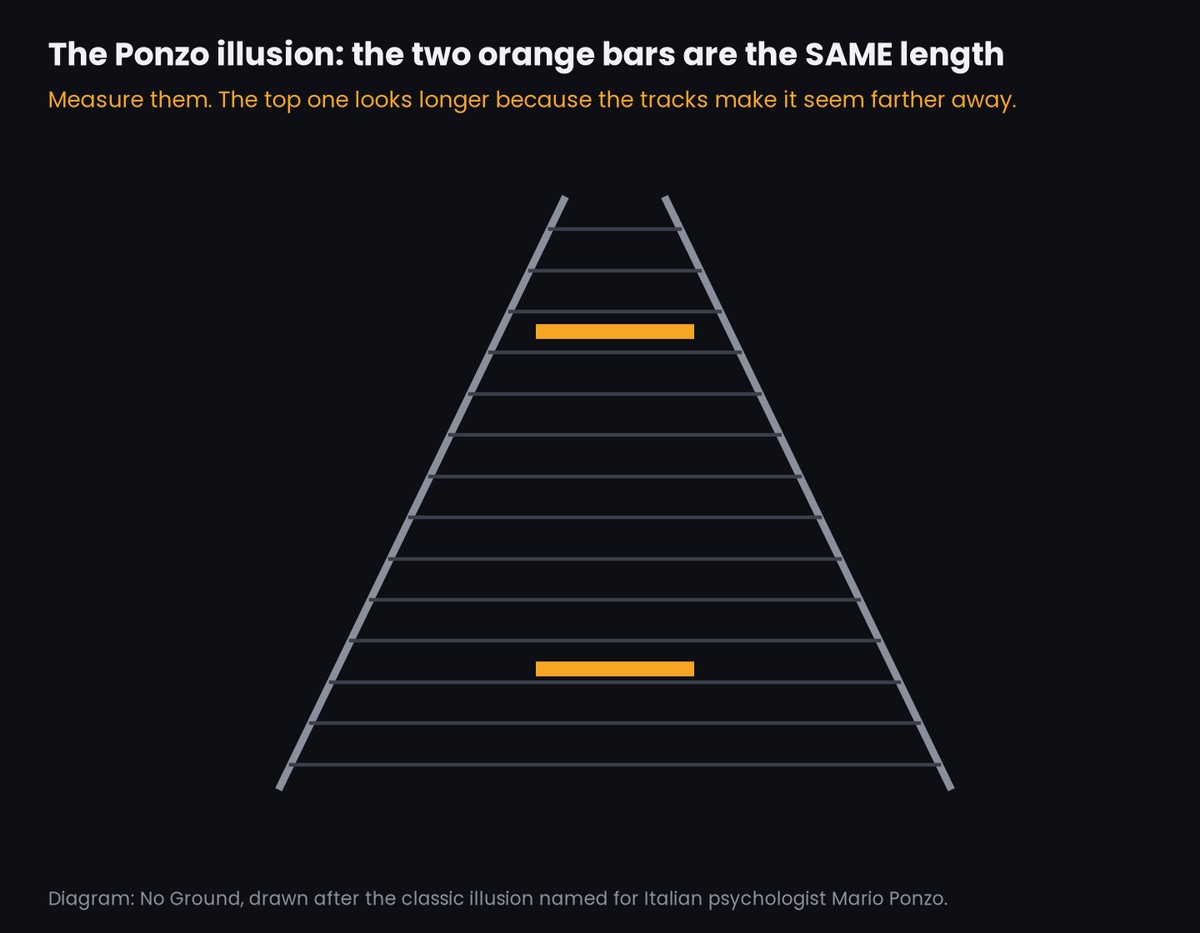
One classic illusion shows how. In the Ponzo illusion, named for Italian psychologist Mario Ponzo, two bars of exactly the same length sit between converging lines, like railroad tracks running into the distance. The upper bar looks longer, because the tracks make it seem farther away. If something looks the same size but seems farther away, your brain concludes it must be bigger.
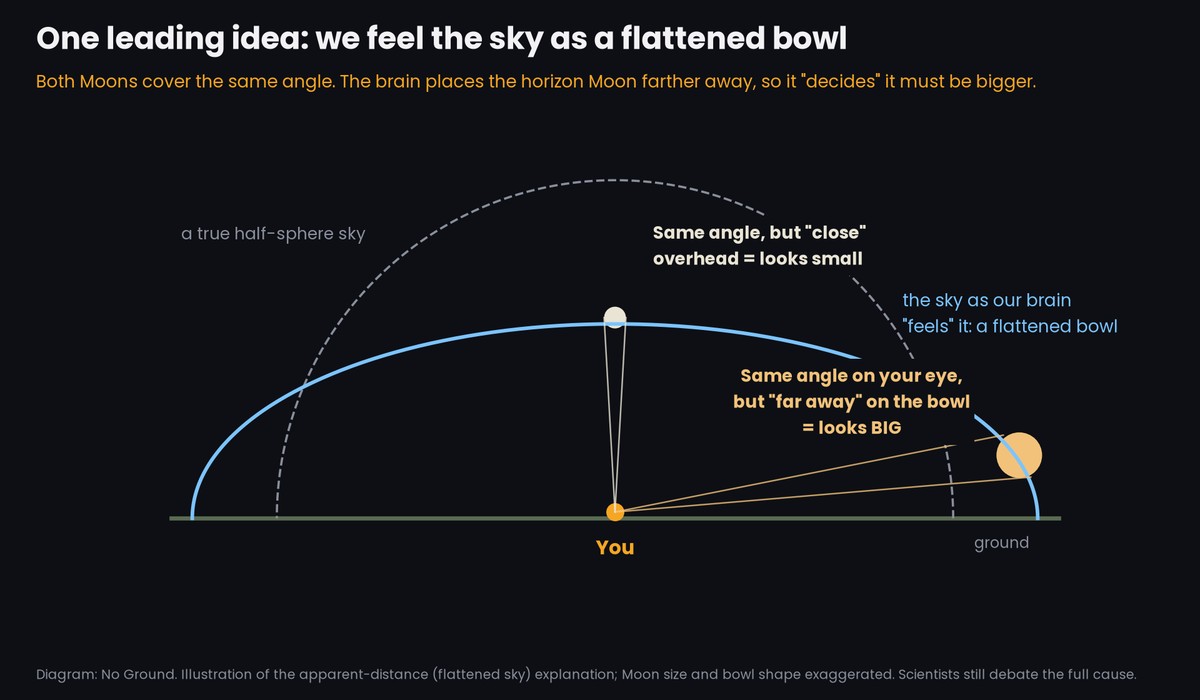
Now apply that to the sky. Scientific American points out that we don’t feel the sky as a perfect dome over our heads. We feel it as a flattened bowl, close overhead and far away at the edges. That makes sense from everyday life: clouds overhead may be about 3 miles up, while clouds near the horizon can be more than 60 miles away.
Explore your sky tonightLive sky map for where you are: planets, the ISS and bright stars above your horizon.So when the Moon sits near the horizon, your brain quietly places it on the far rim of that bowl. It covers the same small angle as always, but your brain thinks it is far away, so it inflates the size. When the Moon climbs overhead, your brain places it on the “close” part of the bowl, and the same angle feels small.
This idea is old. Around 1,000 years ago, the scholar Ibn al-Haytham argued that an object of fixed size looks bigger when it is perceived as farther away. Modern experiments back him up. In tests in the 1950s and 1960s, psychologists Irvin Rock and Lloyd Kaufman found people could see the horizon Moon as up to about three times larger. In a study published in 2000 in the Proceedings of the National Academy of Sciences, Lloyd Kaufman and James Kaufman used artificial moons and confirmed that people perceive the horizon moon as farther away, and they concluded that this is why it looks larger.
Why scientists still argue about it
If the flattened-sky idea is so good, why does NASA say there is still no consensus? Because the illusion has some stubborn puzzles.
The biggest is a paradox. Ask people about the giant rising Moon and many will say it looks bigger and closer, not farther away. Some researchers think it works the other way around: something makes the high Moon look smaller first, and only then does it seem farther away. The Kaufmans described this competing family of explanations in their paper, and disagreed with it.
Another clue: foreground objects are not the whole story. Trees and buildings may help, but Scientific American notes that the illusion still happens over an empty sea or open plains. And NASA notes that astronauts in orbit see the Moon illusion too, with no landscape at all to act as a distance cue. NASA adds that it is not only the Moon: constellations look bigger near the horizon too.
People have been puzzling over this for a very long time. The illusion is described on a clay tablet from the Assyrian city of Nineveh dated to the seventh century B.C.E., and Aristotle wrote about it. Most researchers now agree it happens in the brain, not in the sky, but exactly which brain trick does most of the work is still being tested.
Why giant-Moon photos look so huge
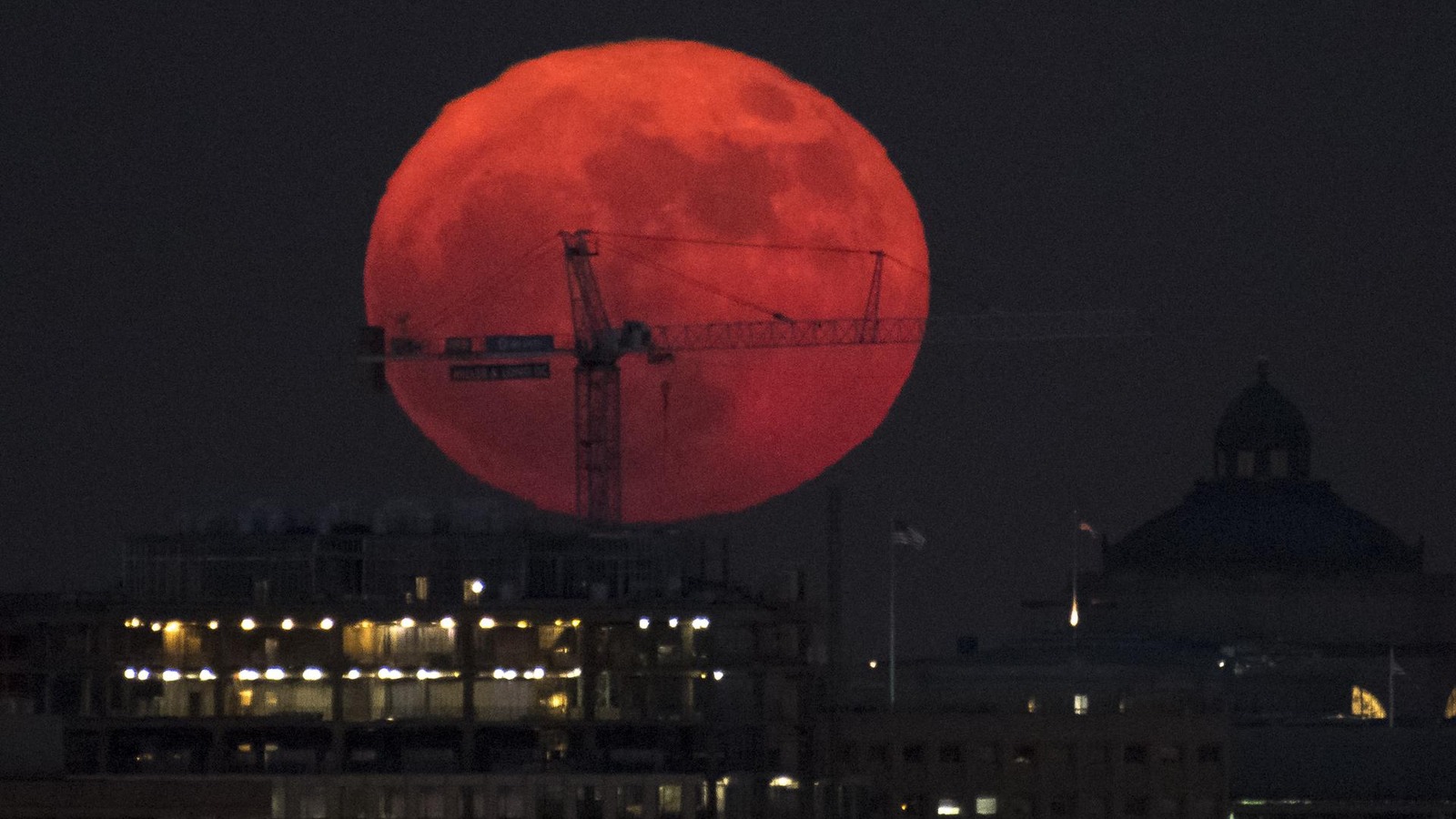
Those viral photos of a gigantic Moon behind a city skyline are real, but they are not showing the illusion. They are showing a zoom lens. NASA explains that photographers stand far from buildings or trees and use a long lens to zoom in on both the Moon and the distant landmarks at once. The Moon stays the same size in the sky, while the zoomed-in buildings now look tiny next to it.
The photo at the top of this page is a good example. NASA photographer Bill Ingalls captured the Moon rising over Washington on Dec. 3, 2017. The camera data stored with the image lists a 500 mm lens, a powerful telephoto zoom. To your naked eye, that same Moon covered only about half a degree of sky.
What about supermoons? Those are real size changes, because the Moon’s orbit is slightly oval. Using NASA’s average figures, the Moon at its closest point looks about 12% wider than at its farthest point, by our math. That is a real difference, but it is small compared with the illusion, which can make a rising Moon seem several times bigger. You can read about upcoming supermoons in our sky guide, and about the Moon’s very slow drift away from us in The Moon Is Slowly Leaving Us.
Bottom line: The Moon does not get bigger near the horizon. It is actually about 1.5% farther away than when it is overhead. Your brain judges the horizon as far away, so it inflates the Moon’s size there, an illusion so strong it works even for astronauts in orbit. A finger at arm’s length or a paper tube will shrink the giant Moon back to normal.